Flight History
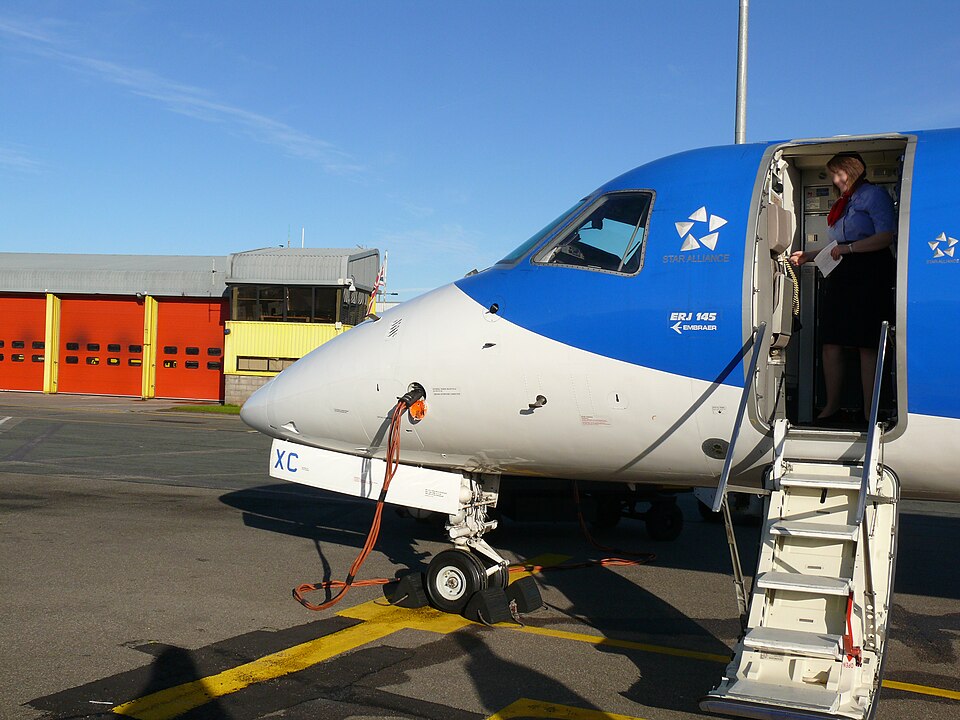
On 15 February 2002, an Embraer EMB-145EP (registration G-RJXC) departed Leeds Bradford International Airport for a scheduled passenger flight to Charles De Gaulle Airport, Paris. The aircraft carried 4 crew and 44 passengers. During the climb through flight level (FL) 250, the crew received a MAIN DOOR OPN warning on the Engine Indication and Crew Alerting System (EICAS), followed shortly by a HYD 2 LO QTY advisory. The commander leveled the aircraft at FL270. The first officer selected the Hydraulics System page on the Multi Function Display, indicating No 2 hydraulic fluid quantity in the amber range (less than one litre).
The crew performed the HYDRAULIC SYSTEM LOW QUANTITY checklist from the Quick Reference Handbook (QRH) and decided to divert to East Midlands Airport. As they coordinated with air traffic control, the No 2 hydraulic quantity continued to decrease, prompting the first officer to execute the HYDRAULIC SYSTEM 2 FAILURE checklist.
Radar vectors were provided for an approach to Runway 27. While passing abeam the airfield with flap 9° extended, the crew noted a decrease in No 1 hydraulic system quantity. Concerned about a possible manual reversion of flight controls, they requested an expedited approach. The commander selected speedbrakes to OPEN; they deployed normally at 207 knots. When the commander selected speedbrakes to CLOSED 33 seconds later, the EICAS speedbrake indicator showed CLD. One second before closure, a Master Caution event occurred with low pressure on No 2 hydraulic system, which persisted after landing.
Thirty-four seconds after the speedbrakes closed, the right outboard spoiler opened uncommanded, followed two seconds later by the left outboard spoiler. Ten seconds after the right spoiler opened, the Master Caution aural alert sounded; the crew believed a SPOILER FAIL message appeared. The spoilers remained open for 35 seconds then closed. Approximately 28 seconds later, as the crew selected flap 22°, the left spoiler reopened and remained open until touchdown.
About 3 miles from touchdown, the crew selected landing flap 45°. Almost immediately, the commander observed the autopilot applying right aileron to maintain wings level. Twelve seconds later, with 17° of right control wheel, he disengaged the autopilot and needed increasing right aileron, approaching full deflection. He requested the first officer assist with aileron trim. The aircraft remained controllable, and the approach continued. The DFDR recorded 20% right control trim and 20% right control wheel during the approach; at about four seconds before landing, roll trim increased to 85% right.
The landing was uneventful. Upon touchdown, both inboard spoilers deployed as ground spoilers. Thirty seconds after touchdown, one second before ground spoilers closed, the No 2 hydraulic low pressure indication disappeared and the right outboard spoiler opened. One second later, inboard spoilers closed and the low pressure indication reappeared.
During the landing roll, a BRAKE OVERHEAT caution activated. The crew stopped the aircraft clear of the runway and requested fire service assistance, which found no fire. The aircraft was shut down and towed to a parking stand. Passengers disembarked normally.
Weather at the time was fine with scattered clouds and no icing. Surface wind at East Midlands Airport was variable at 2 knots; winds between the surface and 2,000 feet were north to north-westerly at 10 to 15 knots.
Examination of the Aircraft
Post-flight examination revealed hydraulic oil leaking from the right engine cowling. The No 2 system reservoir was nearly empty; No 1 system contents were normal. When electrical power was applied, EICAS indicated No 2 system contents at the bottom of the amber range and No 1 system at approximately two-thirds of the green range.
The leak was traced to a loose connection of the No 2 engine-driven pump (EDP) case tube drain union, located in the engine/fuselage stub wing. No evidence of recent maintenance in that area was found. The main door open warning could not be reproduced on the ground and appeared spurious.
Tests on a serviceable aircraft of the same type established that a CLD indication could be obtained without the speedbrake panel being locked. By deploying the speedbrakes, shutting off hydraulic power, dissipating pressure, and selecting CLOSED, the panels could be manually inched down until the OPN indication changed to CLD. This occurred with the trailing edge raised about 20 mm and the actuator lock not engaged. A SPOILER FAIL caution appeared after a 10-second delay, which is by design.
Conclusion
No probable cause is stated in the source.