Incident
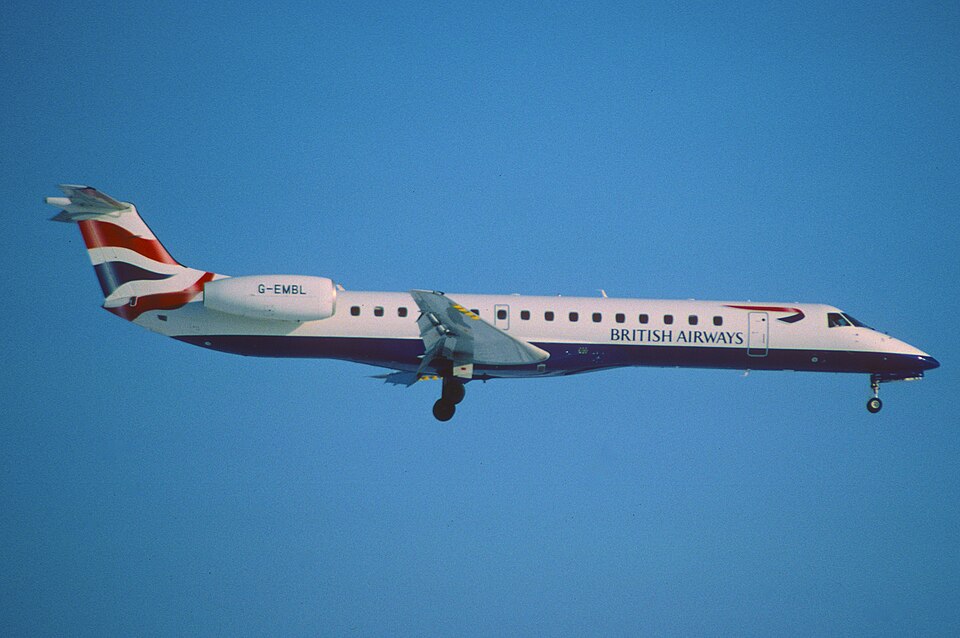
On 18 November 2003, an Embraer EMB-145EU, registration G-EMBL, was departing Birmingham Airport for a passenger flight to Dusseldorf, Germany. During the takeoff roll, the commander noted a more positive rate of rotation than usual. After rotation, a vibration was felt through the control column, and a passenger reported a loud banging noise from below the aircraft that intensified with speed. The cabin crew alerted the commander to a noise around rows 15 and 16, present since takeoff. The commander slowed the aircraft, levelled at FL90, and requested a return to Birmingham. A PAN call was made, and the aircraft landed on Runway 33 with fire services in attendance. No fire was evident, and the aircraft taxied to the stand.
Damage and Inspection
After landing, ground staff informed the commander that the left inboard main wheel (number 2) tyre had shed its tread. The detached tread had flailed, with pieces becoming trapped between the main gear and its side stay. The main gear showed signs of contact, and the trailing edge of the left flap was damaged by the departing tread. The number 2 tyre had deflated and exhibited a large sidewall split. The wheel and tyre assembly, along with its companion outboard tyre, were removed for investigation. Small pieces of tread were recovered from the runway side.
Flight Recorder Data
The aircraft was equipped with a flight data recorder (FDR) and cockpit voice recorder (CVR). During taxi, rhythmic noises from the wheels passing over taxi lights were recorded. The takeoff rotation speed was 154 kt with Flap 9 selected. Two minutes after takeoff, the commander mentioned elevator flutter. Cabin crew reported a knocking noise from underneath. Four and a half minutes after takeoff, the crew decided to return. The approach and landing were normal, with Flap 45 selected and a touchdown speed of 129 kt. After landing, the knocking stopped when the landing gear was extended. ATC later reported finding a lump of rubber on the runway. Brake pressures after landing were higher than average, and a brake overheat warning occurred five minutes fifty seconds after touchdown. The crew noted the landing may have been near maximum landing weight.
Wheel and Tyre Analysis
The main wheel assembly on the Embraer 145 uses two forged aluminium alloy halves joined by tie bolts, retaining a tubeless tyre. Three thermal relief (fuse) plugs are fitted, designed to relieve pressure at high temperatures. The failed tyre was a 30 x 9.5-14, 16-ply rated cross-ply tubeless tyre. The tread had separated due to overstress in the sidewall, leading to casing ply break-up. Air penetrated through the inner wall failure and permeated the casing, causing the tread package to lift. The overstress was attributed to the tyre running under-inflated, possibly from leakage through the wheel fuse plugs.
Retread and Inspection Context
At the time, the operator's tyres were limited to retread level 3, though the manufacturer was investigating an escalation to level 4. One level 4 retread had failed in service. Tyre inspections by the retreader include visual checks and non-destructive testing (Shearography) to detect adhesive issues. The tyre from G-EMBL had undergone such inspections. The source notes that a tyre run under-inflated is immediately scrapped due to increased stress.
Safety Recommendations
The AAIB issued four safety recommendations concerning the maintenance of Embraer 145 wheels and tyres.