History of the Flight
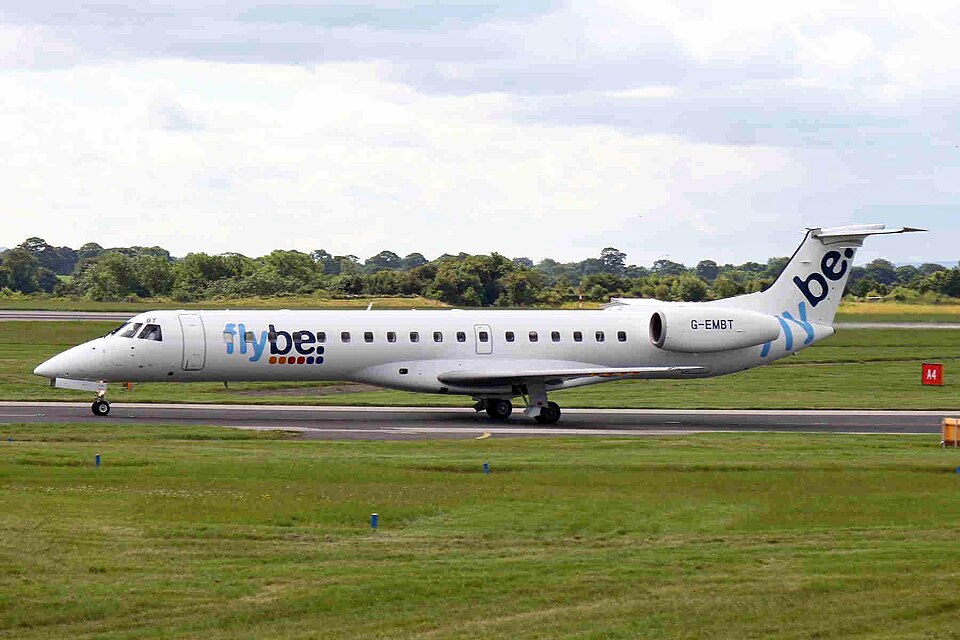
The aircraft, an Embraer EMB-145EU registered G-EMBT, was on a public transport passenger flight from Edinburgh to Bristol Airport. The commander, aged 40 with 8,000 total flying hours (3,300 on type), took manual control after becoming visual with Runway 27 at approximately 500 ft above ground level during an ILS approach. The last reported wind was a direct crosswind of 23 to 27 kt; the crosswind landing limit was 30 kt. Considering a drift angle of about 15°, the commander judged the crosswind exceeded the limit and initiated a go-around.
During the second approach, the commander became visual between 700 ft and 500 ft. After decision altitude, air traffic control reported a crosswind of 31 kt. The commander considered another go-around but continued after a subsequent wind report of '30 kt across'. The aircraft touched down on the runway centreline near the touchdown markers. Heavy manual braking was applied. During the ground roll, directional control began to degrade, requiring a large rudder pedal input. The commander felt loss of hydraulic rudder assistance, followed by a Master Caution warning and a 'rudder sys 1-2 inop' EICAS message. He maintained control using asymmetric braking and was uncertain if the rudder pedals were effective. Below 40 KIAS, he used the tiller to steer and exited the runway normally.
Weather and Runway Surface Conditions
At 1950 UTC, 11 minutes before the incident, weather was reported: broken cloud at 400 ft, wind from 180° at 26 kt gusting to 43 kt, light rain, visibility 4,000 m, temperature 11°C. The last runway condition report at 1923 UTC indicated 'Damp-Wet-Damp', with the centre section soaked to less than 3 mm depth. A 300 m section of the runway had been recently resurfaced and was not yet grooved.
Rudder Control System Description
The rudder on the EMB-145 consists of forward and aft sections. The forward rudder is powered by two hydraulic actuators through a Power Control Unit (PCU), commanded by rudder pedals via cables. The PCU is dual hydraulic, powered by two systems. Either system can be shut off automatically or manually. When both hydraulic systems are off, the rudder operates mechanically with higher control forces. The EICAS displays 'rudder sys 1-2 inop' when both systems are inoperative.
Rudder Hardover Protection System (RHPS)
The RHPS removes hydraulic power to the rudder PCU in case of a runaway. It shuts off both systems if three conditions are met simultaneously: (1) rudder pedal force >130 lbf, (2) rudder deflection >5° opposite to pedal force, and (3) both engines operating (N2 >56%). The pedal force is measured by spring-loaded cartridges with microswitches. Condition 3 disables RHPS during engine failure. RHPS indirectly triggers the 'rudder sys 1-2 inop' message.
Brake System Description
The EMB-145 has disc brakes on each main wheel, controlled by toe brakes on the rudder pedals. The anti-skid system modulates brake pressure to prevent skidding. Asymmetric braking requires reducing pressure on the opposite side. Maximum braking force is achieved at 61.9 lbf and 15° pedal deflection.
Flight Data Recorder Analysis
The FDR recorded over 25 hours. On the second approach, the aircraft heading was slightly left of Runway 27, increasing as it neared the runway with right rudder pedal and left roll inputs. Touchdown occurred at 19:59:47 with an airspeed of 124 kt, heading 266°, rudder pedals deflected 4.6° right, control wheel 37° left. Ground spoilers deployed, braking applied, and further right rudder inputs followed. Deceleration peaked then decayed from -0.37 g to -0.16 g. Engine N2 remained at idle (62-67%). At 20:00:01, a master caution was triggered at 79 kt groundspeed, likely from RHPS. The 'rudder sys 1-2 inop' message requires a 3-second confirmation. The event triggering the master caution likely occurred 3-4 seconds earlier, during which rudder pedal deflection was at least 4° (equating to 6.7° right rudder).
Previous Incidents
The manufacturer reported prior occurrences of dual rudder system shutoff during landing, attributed to excessive pedal force in strong crosswinds, though difficult to confirm. The operator of G-EMBT experienced a similar incident on another EMB-145 (G-EMBI) on 9 January 2007 during landing at Birmingham Airport, where directional control was maintained using differential braking.
Engineering Rectification
Post-flight, engineers cycled both rudder systems on and off, which restored hydraulic power and normal operation. No fault was found in the aircraft, and no evidence of a rudder runaway was discovered. High rudder pedal or brake pedal forces, or incorrectly adjusted pedal force microswitches, may have triggered the RHPS.