Accident Summary
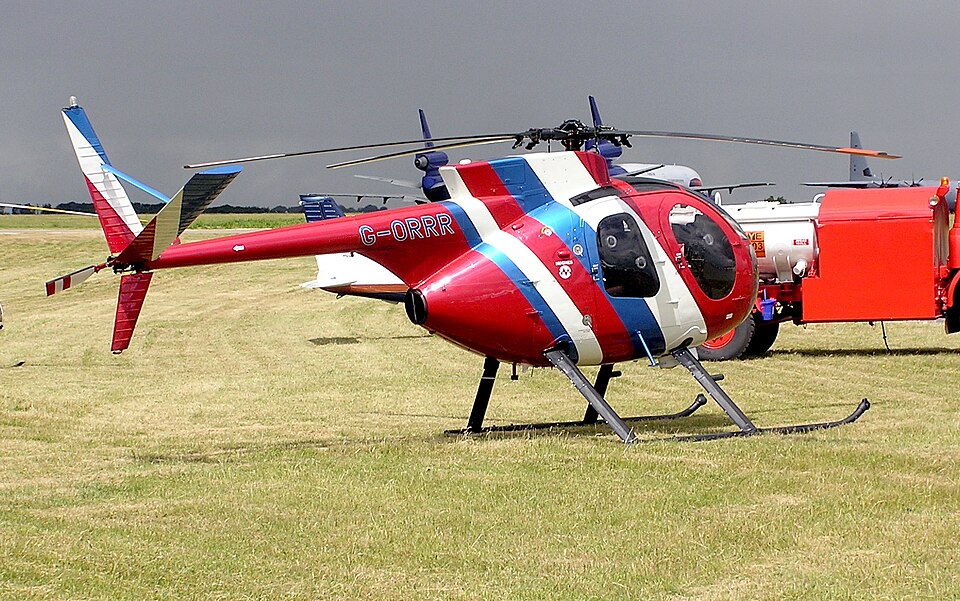
On 9 May 2006 at 1306 UTC, a Hughes 500C-369HS helicopter, registration G-ORRR, was destroyed following an accident at Hanover Hill, Lane End, near High Wycombe, Buckinghamshire. The single-engine helicopter, powered by an Allison 250-C20 turboshaft engine and manufactured in 1975, was on a private flight from Checkendon to Wycombe Air Park. The sole occupant, a 47-year-old male private pilot with 118 total flight hours (18 on type), was uninjured. The helicopter sustained severe damage and was destroyed.
History of the Flight
The pilot intended a short five-minute flight from his private site at Checkendon to Wycombe Air Park for refueling. After departure, he contacted Benson radar and climbed to 1,200 ft amsl. Near Henley, he reported visual contact with Wycombe and was instructed to switch to Wycombe Tower. As the helicopter approached the airfield, the pilot reduced engine torque from 50% to 40% and speed from 95 kt to 80 kt. He made an initial radio call, received airfield information, and set the altimeter subscale. At approximately 750 ft over woodlands 2.5 miles west of the airfield, he acknowledged a message about two other helicopters operating from the airfield. Shortly after, he reported experiencing power fluctuations.
The pilot described that as engine power fluctuated, the helicopter's nose yawed right, then pitched up and yawed left. Believing engine power dropped to nothing, he lowered the collective and entered autorotation. He turned 180° into wind and selected a landing site. At about 450 ft and 60 kt, he began a MAYDAY call but then reported the power seemed to return, prompting him to break off the call and raise the collective. However, the engine did not respond, and rotor speed and airspeed decreased. At approximately 100 ft above ground and 30 kt, near a group of trees, the pilot pushed the cyclic forward to regain airspeed. He raised the nose when 40 to 50 ft above a hilltop, but the helicopter suddenly dropped. It struck the ground on the back of the skids and tail boom, pitched forward, and the main rotor blades hit the ground. The helicopter was then thrown violently onto its left side, and the main rotor blades detached from the rotor head, which was still turning under power. The pilot closed the fuel cock and turned off the engine before exiting through the right door.
Aircraft Information
The Hughes 500C is a free turbine, turboshaft-engine-powered helicopter with a four-bladed fully-articulated main rotor and a two-bladed semi-rigid tail rotor. The fuselage is semi-monocoque aluminum alloy. G-ORRR was equipped to carry two pilots in front and three passengers in the rear, with two non-retracting skids and an automatic re-ignition system.
The fuel system comprises two interconnected flexible fuel cells beneath the passenger compartment. A start fuel pump in the left cell provides fuel for engine starting; once started, fuel is drawn by the engine-driven pump. A fuel shut-off valve, operated by a push-pull cable, is located on top of the left cell. The fuel gauge indicates contents in 100 lb increments with a red dot at 35 lb. A FUEL LOW caution light illuminates at approximately 35 lb. The helicopter also carried a 21 USG auxiliary fuel tank behind the rear seat, without a content indication system, fed via its own shut-off valve into the right fuel cell. The Flight Manual Supplement describes the auxiliary fuel transfer procedure.
The Flight Manual, under PARTIAL POWER LOSS, states that the engine may operate smoothly with reduced power or erratically, and turning the start pump ON may smooth out erratic operation, but the need to land must not be disregarded. It also notes that a loss of torque will result in a yaw to the left and a drop in engine and rotor speed.
Recent maintenance included a 100-hour annual servicing and a 300-hour engine inspection approximately six hours before the flight, during which the engine was removed and compressor casings were replaced. No recent faults were reported.
Examination and Findings
The helicopter and engine were examined at the AAIB Headquarters. Damage was consistent with the main rotor turning under power when the blades struck the ground. Magnetic plugs in the main gearbox were clear of debris. The tail pylon aft of the engine compartment was distorted, and the tail rotor drive shaft had torn through the drive shaft tunnel. The left-side glazing cracked, and structure around the pilot's door and floor frame was distorted. Both skids broke off near the bottom of the down struts.
During fuel system examination, the low-pressure fuel cock operating cable had pulled out of the operating arm, which remained in the fully open position. The cable lever came out further than normal, possibly indicating the cable had disconnected. However, due to the detent in the open position, it was considered unlikely that the cock moved during flight. The pilot confirmed the cable became disconnected after the accident.
The investigation could not identify the cause of the reported power fluctuations.