History of the Flight
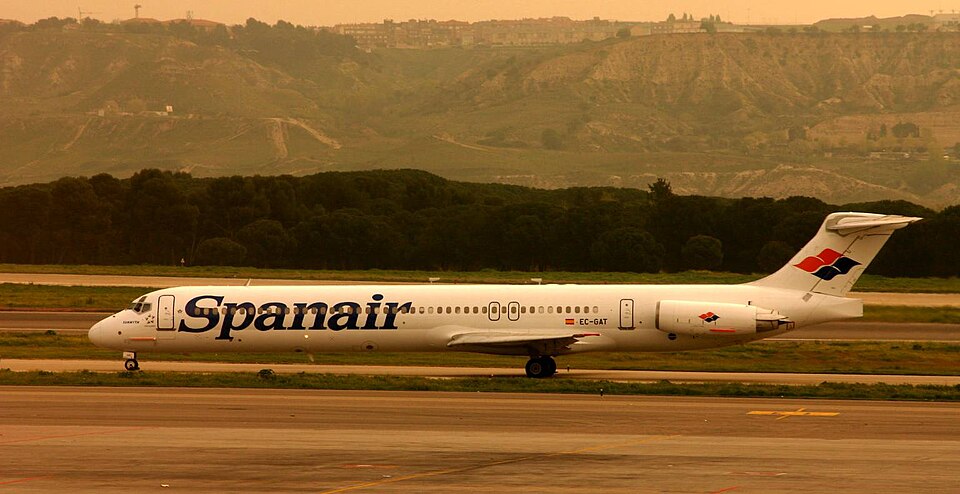
On 9 January 2006, shortly before 09:00 UTC, an MD-83 aircraft with registration EC-GAT, operated by Spanair, was approaching runway 07R at Barcelona-El Prat Airport. The aircraft was operating scheduled flight JKK-6513 from Bilbao, carrying 90 passengers and a crew of six. The captain served as pilot flying, and the first officer as pilot not flying.
The approach began with the aircraft at a relatively high altitude on a heading of 150°. Air traffic control reminded the crew not to descend below 5,000 ft before crossing the coastline, a restriction recently imposed for environmental reasons. The aircraft cut short its turn to intercept the ILS localizer at the final approach fix, flying at 3,700 ft and 260 kt indicated airspeed. Being above the glideslope, the descent became very steep, averaging about 2,500 ft/min. On short final, the aircraft was established on the glideslope but at high speed and while transitioning to flaps 40° configuration, meaning the approach was not stabilized.
The aircraft crossed the runway threshold at a correct altitude of 50 ft but at 200 kt. The reference speed (Vref) was 124 kt, and the target speed (Vtarget) was 129 kt. Tire tracks indicated that the main landing gear did not touch down until past the halfway point of the runway, approximately 1,600 m from the threshold. During braking, all four main gear wheels locked and began to skid before blowing out.
The aircraft came to a stop on the runway centerline about 140 m before the end. When the crew attempted to taxi off the runway, they found the wheels locked. A tower controller observed flames on the left main gear, prompting the crew to order an immediate evacuation. Firefighting services arrived quickly and extinguished the fire. Passenger buses transported passengers from the aircraft about 25 minutes after the incident. Some passengers sustained minor injuries during the evacuation.
Damage to Aircraft
The aircraft sustained damage to both wings and the tail assembly. Both main landing gear legs were damaged by the high-energy braking. The tires, rims, and brakes on both sides showed friction damage from contact with the runway; those on the left leg were also affected by fire. Hydraulic lines in the left main gear leg ruptured due to friction and impact. Fire damaged the inboard flap, skin panels, and gear doors on the left wing. The lower tail cone was damaged and cracked after being ejected during deployment of the rear slide. Inspections revealed no apparent damage to the aircraft's primary structure.
Personnel Information
The captain, aged 40, held an Airline Transport Pilot License (ATPL) with 6,012 total flight hours, 4,612 on type. The first officer, also 40, held an ATPL with 3,400 total hours, 2,926 on type. In addition to the cockpit crew, three flight attendants and a purser were in the cabin.
Aircraft Information
The MD-83 is a medium-range twin-engine passenger aircraft. The airframe (manufactured by McDonnell Douglas in 1988) had a valid airworthiness certificate until 14 February 2006, with 41,627.49 total hours and 27,472 cycles. The estimated landing weight was 114,000 lb, below the maximum allowed 140,000 lb. The landing gear and flap operating speeds were standard. The antiskid system was confirmed to be ON after the incident. The aircraft was equipped with autobrake and spoiler systems.
Meteorological Information
The 09:00 UTC METAR reported wind from 350° at 11 kt, visibility over 10 km, few clouds at 2,500 ft, temperature 8°C, dewpoint 4°C, QNH 1026 hPa. The runway was dry. The controller reported wind from 350° at 10 kt to the crew.
Communications
A review of communications with approach control and the tower revealed no notable deviations beyond the standard instructions.