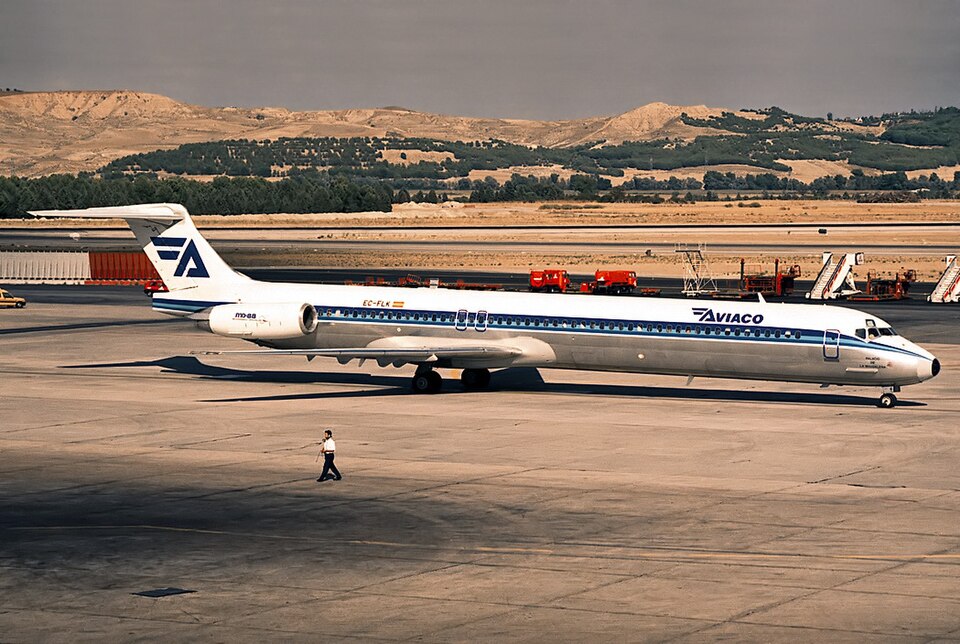
On June 18, 2004, a McDonnell-Douglas MD80 Series (registration EC-FLK) was involved in an aviation accident near Aeropuerto de Madrid-Barajas (Madrid), ES. No fatalities were reported. Investigators recorded the probable cause as: The cabin smoke was probably caused by the water separator blankets in the air conditioning system becoming saturated with oil from the APU, due to the loss of seal integrity of the No. 1 front compressor bearing oil seal and a leak in the APU oil pump. This summary draws on records from the Spanish Civil Aviation Accident and Incident Investigation Commission (CIAIAC).
On June 18, 2004, an Iberia McDonnell Douglas MD-88 (EC-FLK) returned to Madrid-Barajas after cabin smoke. APU oil leaks were identified as the probable cause.
Incident Overview and Flight Details On Friday, June 18, 2004, at 18:30, an Iberia McDonnell Douglas MD-88, registration EC-FLK, serial number 53304, was operating a scheduled domestic passenger flight from Madrid to Alicante. The aircraft was carrying five crew members and 151 passengers. During the pre-flight inspection, the crew reported no anomalies. Due to an ambient temperature of approximately 32 °C, the crew requested an air conditioning unit to supplement the Auxiliary Power Unit (APU) for cabin conditioning. ## Event Sequence After the preceding aircraft was cleared for takeoff, the crew disconnected the APU and initiated the takeoff. At an altitude of approximately 3,500 to 4,000 feet, the crew began to notice smoke in the flight deck with a sweet odor. They requested to maintain 5,000 feet and return to the airport, though they did not initially declare an emergency while assessing the source of the smoke. The crew was informed that smoke was also present in the passenger cabin and instructed the cabin crew to calm the passengers, stating that a normal landing would be performed. Upon leveling off at 5,000 feet, the smoke flow ceased, and the crew decided to continue without declaring an emergency. They executed an emergency return procedure and landed without further incident on runway 33 at Madrid-Barajas Airport approximately 14 minutes after takeoff. Following the landing, normal operations continued, and all occupants disembarked in a routine manner. ## Maintenance Findings and APU Inspection Operator maintenance personnel observed a high consumption of APU oil, which had entered the air conditioning ducts. The ducts were cleaned, and the air conditioning blankets were replaced. APU operation was deferred under MEL category “B.” Two days later, the APU was replaced, and no similar malfunctions were subsequently reported. The aircraft was equipped with a Garrett gas turbine APU. The APU shaft was supported by a front compressor bearing (No. 1) and a rear turbine bearing (No. 2). The bearings featured carbon seals designed to prevent lubricating oil from mixing with external air. The removed APU (P/N 381276-1; S/N P1053) had 18,897 hours since manufacture and 547 hours since its last overhaul. During the shop inspection, a damaged flange and soot residues were found in the exhaust outlet duct and load valve. Vacuum loss was observed in the accessory case cavity with the front bearing (No. 1) and in the turbine bearing (No. 2) cavity. Borescopic inspection detected no damage to the two compressor stages, turbine blades, or turbine nozzle, but a large amount of oil was observed in the compressor area. During disassembly, the carbon seal of the No. 1 compressor bearing was found to be deteriorated at its contact surface with the sealing plate. The No. 2 turbine bearing seals were removed, but no apparent deterioration of the sealing carbons was observed. A functional check of the APU oil pump revealed leaks at the joint between the two pump bodies. No leaks were found in the remaining accessories. ## Probable Cause and Safety Recommendations The operator's engine shop concluded that the loss of seal integrity of the No. 1 front compressor bearing oil seal, along with the oil pump leak, was the most probable cause of the APU oil loss into the aircraft. The No. 2 turbine bearing leak, which did not retain vacuum but appeared to have intact seals, would have caused oil loss to the APU exhaust without affecting the aircraft's air conditioning system. The analysis concluded that the cabin smoke, accompanied by a sweet odor, was probably caused by the water separator blankets in the air conditioning system becoming saturated with oil from the APU. The major leak of APU oil into the bleed air duct probably occurred through the No. 1 front bearing seal, although it is possible that at least some of the oil leaking from the APU oil pump also entered that duct. The aircraft logbook showed that since May 16, 2004, there had been various previous reports of APU oil problems, generally indicating low APU oil pressure and oil leaks requiring frequent oil replenishment. However, there were no reports of strange odors or cabin smoke. On May 19, 2004, an oil leak inspection was performed, and a small leak at the test module was found and corrected. On June 15, 2004, the APU air intake door was replaced, and on June 17, 2004, oil was topped up to level. The next day, the cabin smoke occurred. The incident highlighted the need to carefully analyze repetitive malfunctions reported by pilots to detect their ultimate cause before serious consequences occur. Safety recommendation 11/04, issued after incident IN-62/2002, was considered applicable, recommending that the Spanish DGAC urge Iberia to improve its methods for analyzing crew abnormality reports, consulting with the manufacturer when necessary, to prevent the intermittent appearance of the same report and to disseminate useful information to flight crews and maintenance personnel.