History of the Flight
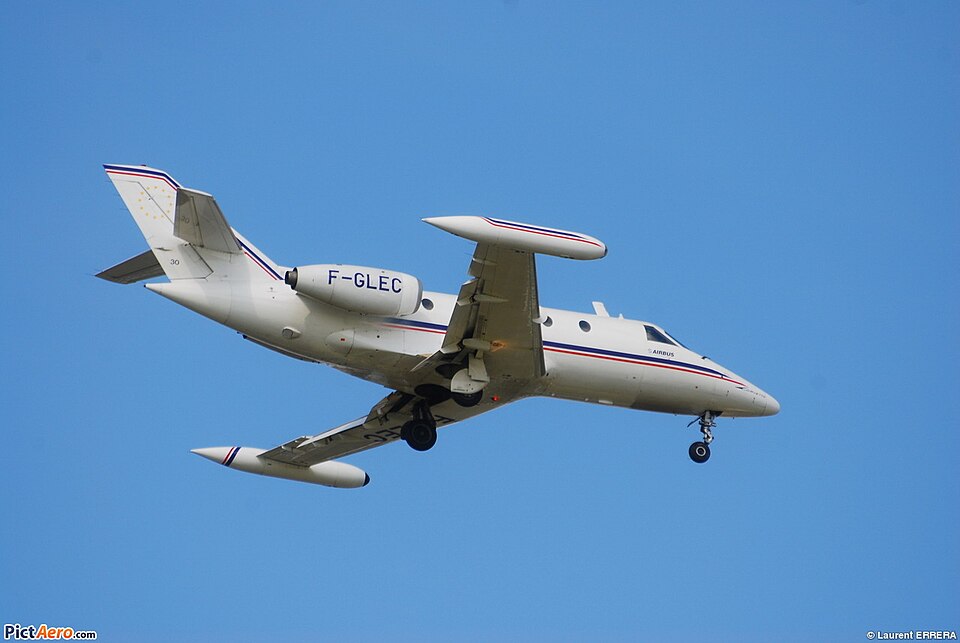
On 4 September 2008, an Aerospatiale SN-601 Corvette, registration F-GLEC, operated by Airbus, conducted a flight from Toulouse to Seville, landing at 06:45 UTC. The return flight was scheduled for 15:35 UTC with the same crew and eight passengers. After a normal taxi, the aircraft began its takeoff run at 15:26 UTC. Once airborne, the crew braked the tires per normal procedures and attempted to retract the landing gear, but the gear lever was locked in place. The aircraft continued climbing.
At 15:29 UTC, air traffic control (ATC) informed the crew that the SSR transponder signal was not being received. The crew acknowledged and stated they would check the equipment. ATC reiterated the requirement for a functioning transponder in that airspace and instructed the aircraft to return. The crew reported their position and turned back. They were cleared to land at 15:37 UTC.
Touchdown occurred at 15:39:30 UTC. During the landing roll, the left wing gradually descended until it contacted the runway, sliding approximately 50 meters before the aircraft stopped within the paved area. There was no fire. An emergency evacuation was conducted, with no injuries to passengers or crew. Emergency services arrived at 15:42 UTC and detected a fuel leak from the left wingtip tank, applying foam to cool the surfaces.
Aircraft Damage
The aircraft sustained minor damage to the left main landing gear leg, fuselage, and left wing. Specifically, the left landing gear leg's shock absorber outer cylinder separated from the piston without evidence of impact or deformation. Damage also occurred to the left wing flaps and left wingtip fuel tank.
Personnel Information
Both crew members held Airline Transport Pilot Licenses (ATPL) and were type-rated on the SN-601, with instrument ratings. The captain, aged 55, had 4,700 total flight hours, including 3,100 on type, and was also a flight instructor on the aircraft. The copilot, aged 44, had 1,200 total hours, 750 on type. The captain was the pilot flying.
Aircraft Information
The aircraft was a twin-engine low-wing Corvette SN-601 (serial number 30) manufactured in 1976, with a maximum takeoff weight of 7,000 kg. The takeoff weight for the incident flight was 6,800 kg. It was powered by two Pratt & Whitney JT15D-4 turbofan engines mounted at the rear of the fuselage. The aircraft had accumulated 14,341 flight hours and 11,137 cycles. Its Airworthiness Review Certificate was valid until 9 May 2009.
The landing gear was a tricycle retractable design with oil-pneumatic shock absorbers. The gear retraction lever was locked in the down position when any shock absorber was compressed, preventing retraction on the ground. The left main gear shock absorber had been overhauled in September 2006 and repaired in January 2008 to correct a hydraulic fluid loss, after which it had flown 224 hours and 140 cycles.
Communications
Communications between the crew and Seville ATC were routine until after takeoff. At 15:28:32, ATC requested confirmation of the SSR code, which the crew provided. At 15:29:05, ATC reported no transponder signal. The crew checked the equipment. After further exchanges, ATC directed the aircraft to return. During the approach, the crew was cleared to land at 15:37:49. At 15:39:46, the crew reported a problem, and ATC observed an anomaly with the left wing. At 15:41:54, the crew reported blocking the runway with passengers safe. At 15:42:42, the crew stated the left gear had not lowered.