Event Description
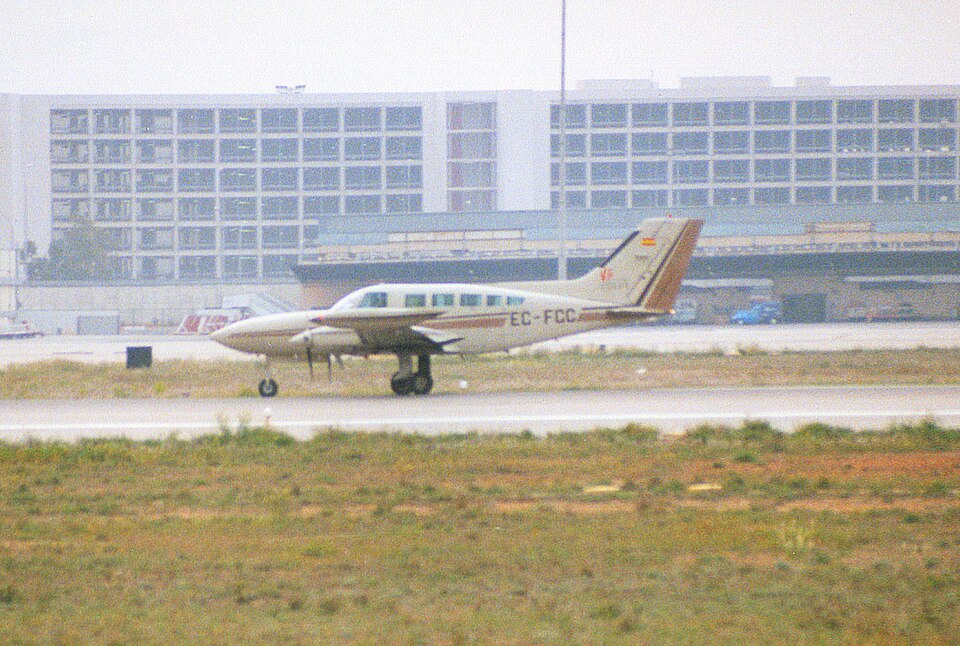
On Saturday, 10 July 2004, at 08:40 local time, a Cessna 402B operated by Victor Echo arrived at Valencia Airport from Palma de Mallorca with a cargo of 300 kg of newspapers. The aircraft was preparing to depart back to Palma. As the flight crew—consisting of a pilot in command (age 28, 1,147 flight hours, 627 hours on type) and a copilot (age 36, 1,100 flight hours, 200 hours on type)—taxied onto runway 12, the pilot released the brakes and increased engine power. A few meters later, the left main landing gear leg collapsed. The left wing and left horizontal stabilizer contacted the ground, and the tips of the left propeller blades struck the runway pavement.
Injuries and Damage
Both crew members were uninjured. The aircraft sustained major damage: the left wing was deformed, the left horizontal tail was damaged, the left landing gear well and doors were affected, and the left propeller blades were completely deformed. The left engine showed no obvious external damage, but there was a possibility it could have been affected by the propeller impact.
Investigation Findings
Visual inspection revealed that the collapse began with the shearing of the bellcrank pivot bolt (part number NAS 464P4-26), which attaches the bellcrank to the landing gear leg. The rearmost fitting remained attached to the leg with the bolt head; the forward fitting broke due to bending, and one of the lower bellcrank fittings tore. The adjusting screw was also deformed. The right main landing gear components were inspected and showed no abnormalities, ruling out common misrigging.
Laboratory Analysis
The failed bolt was sent to a laboratory for fractographic evaluation. Macroscopic and microscopic examination indicated a static failure primarily due to shear loads. Chemical composition analysis confirmed the bolt was a low-alloy steel of type AISI 8740. Hardness testing measured a strength of 142 KSI, which is 11.25% below the minimum requirement of 160–180 KSI specified by NAS464 and NAS498.
Maintenance History
The bellcrank pivot bolts on both main landing gear legs had been replaced on 14 August 2003, during a structural inspection. In the 11 months between replacement and the incident, the aircraft accumulated 352 flight hours and 384 landings. According to the Cessna Supplemental Inspection Document (SID) 32-10-03, initial inspection of these bolts was required at 1,000 landings or 3 years, with subsequent inspections every 500 landings or 3 years. At the time of the event, the left bolt still had a potential service life of 616 landings or 25 months before the next required inspection.
Additional Information
Cessna Aircraft Company reported that they were not aware of any previous cases of this bolt failing. The bolt was traced through a supply chain from Honeywell TPG/Tristar to Cessna, then to Hill Aircraft, and possibly to Nortavia-Transportes Aéreos in Portugal, where it may have been installed on the accident aircraft.
Weather Conditions
Meteorological data from Valencia Airport at the time indicated wind from 100° at 4 knots, CAVOK, temperature 23°C, dew point 17°C, and QNH 1020 hPa. No significant changes were expected.