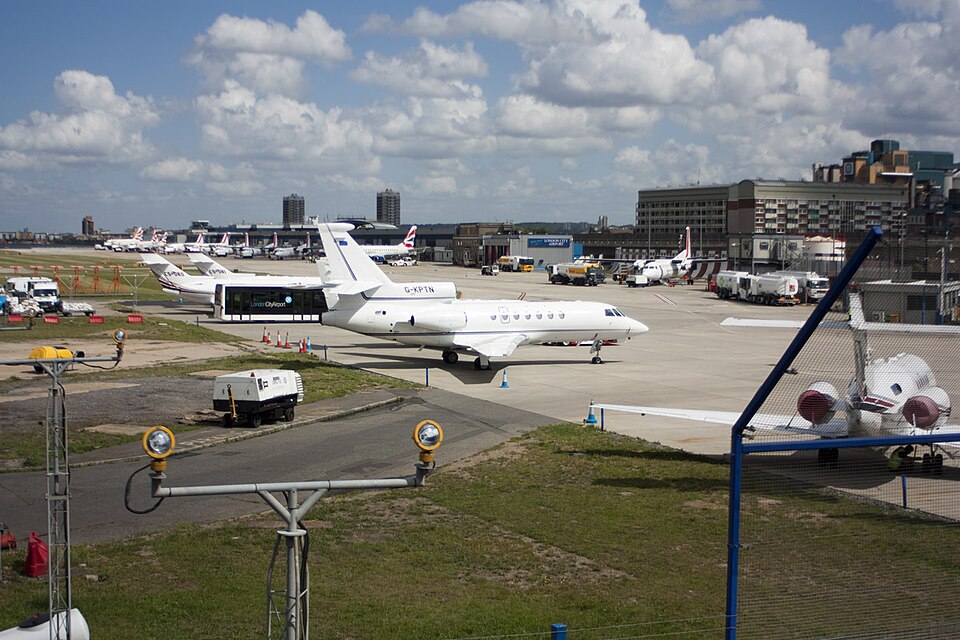
What happened
On 21 January 2010, a Falcon 50, registration G-KPTN, was conducting a positioning flight from Biggin Hill to London City Airport. During the flight, the aircraft descended below its cleared altitude of 2,000 ft amsl. The commander, believing the aircraft was on final approach for Runway 27, initiated a descent to manage what he perceived as an excessively high approach. In reality, the aircraft was on the downwind leg for Runway 09.
As the aircraft descended, the crew experienced confusion regarding air traffic control communications. The commander mistakenly believed the aircraft had been handed over to City Tower rather than City Radar. During the descent, the aircraft reached approximately 1,100 ft amsl, at which point ATC instructed the aircraft to climb. The crew initially queried the instruction, believing a go-around was necessary. During the subsequent climb, the aircraft's spoilers and landing gear remained deployed, contrary to standard go-around procedures. The aircraft eventually regained its cleared altitude and landed on Runway 09 without further incident.
The investigation
The AAIB examined flight data from the Flight Data Recorder and audio from the Cockpit Voice Recorder. The investigation also reviewed radar tracks and ATC transmissions. The investigators analyzed the cockpit environment, noting the lighting conditions near sunset and the complexities of the London City Airport environment. The Enhanced Ground Proximity Warning System (EGPWS) was also tested to determine why no warnings were triggered during the descent.
Findings
- The commander's misidentification of the aircraft's position and intended runway was the primary cause of the descent.
- The crew failed to fully read back ATC instructions, which would have highlighted the error.
- The commander incorrectly believed the aircraft had been transferred to City Tower.
- The use of the same ILS/DME frequency for both runways at London City increased the risk of confusion.
- The requirement to fly the steep approach without autopilot increased the crew's workload.
- Low lighting conditions and the complex urban backdrop of the airport made it difficult to distinguish runway lights.
- The flight director had entered approach capture mode while the aircraft was on a westerly track.
Safety action
Following the incident, the aircraft operator implemented changes to training procedures to mitigate the risk of recurrence and issued safety information to crews regarding the lessons learned. The commander also underwent additional simulator training.