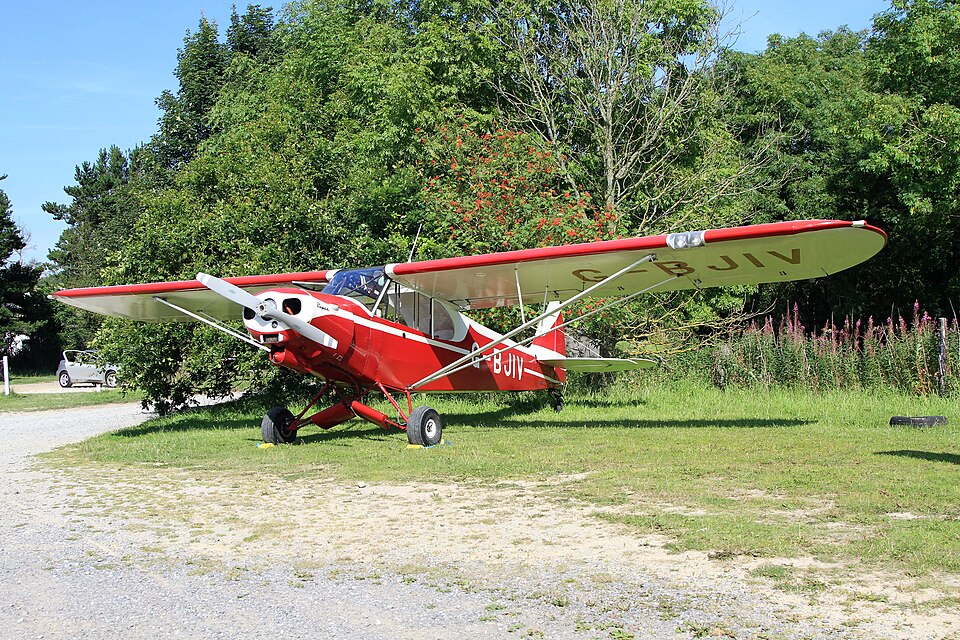
Accident Synopsis
On 23 August 2000 at 1845 hours UTC, a Piper PA-18-150 (Modified), registration G-BJIV, sustained damage after striking overhead wires during a landing approach at Winds Farm, Thorne, near Doncaster, Yorkshire. The aircraft came to rest inverted, having broken three conductors and a wooden pole. The pilot and sole passenger were uninjured and evacuated the aircraft normally.
Flight Details
The aircraft was a modified Piper PA-18-150, built in 1965, powered by a single Lycoming O-360-A3A piston engine. It was being operated on a private flight as a glider tug. The pilot, aged 63, held a Private Pilot's Licence and had accumulated 2,359 total flying hours, including 670 hours on type, with 37 hours in the preceding 90 days and 28 hours in the last 28 days.
Accident Sequence
The flight originated from the gliding club at Plockton, near Kyle of Lochalsh, Scotland. The pilot was tasked with landing at a designated stubble field to aerotow a glider back to Plockton. The glider pilot had previously assessed the field as suitable and stated that the farmer had given permission, but did not mention any obstructions. The field was approximately 300 metres long, oriented east-west, with a road running north-south at the western end. Telegraph wires ran along both sides of the road.
Upon arrival, the tug pilot performed a low-speed left-hand orbit at low level to check the field for obstructions. Weather conditions were good: light easterly wind, high cloud, no precipitation, and good visibility. Deciding there was adequate distance to clear the wires and land, the pilot set up a downwind leg at about 60 mph, lowered initial flap, then on final approach selected full landing flap. Just before flaring, he saw a single-strand feeder cable stretched left to right across his path, which he had not observed during the orbit. He could not avoid it; the cable struck the landing gear, stretched, and then broke. The aircraft pitched down, banked right, and the right wing and propeller hit the ground, causing the engine to stop and the aircraft to somersault inverted.
Pilot's Observations
The pilot concluded that the wires were difficult to detect during his reconnaissance, although he noted that a lower-altitude search might have revealed them. He also suggested that a more thorough obstacle search by the glider pilot and the use of radio communications to highlight hazards could have been helpful, though the source does not state that such communication was available or used.