Accident Summary
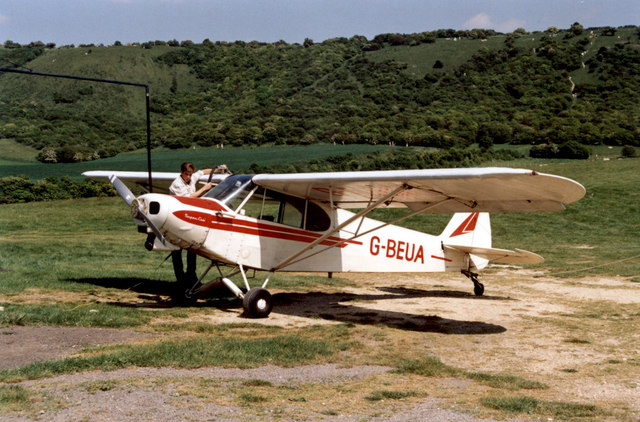
On 8 April 2006 at 1100 UTC, a Piper PA-18-180 Super Cub (registration G-BEUA) experienced a landing gear collapse after landing at Dunstable Airfield, Bedfordshire. The aircraft was on a private flight and had just completed its second glider tow of the morning. As ground speed decreased, the right wing dropped and the wing tip contacted the ground. The engine was shut down with the propeller clear of the ground. The pilot and passenger exited without injury. The aircraft sustained damage to the right landing gear.
Aircraft Information
The Piper PA-18-180 Super Cub, manufactured in 1964, was powered by a single Lycoming O-360-A4 piston engine. It had been operating from Dunstable Airfield almost exclusively for glider towing operations since 1979. The aircraft underwent a complete refurbishment in December 1992. At the time of the incident, the aircraft had accumulated 11,750 flying hours and approximately 58,000 landings. The pilot held a Private Pilot's Licence and had 294 hours total flying experience, with 46 hours on type.
History of the Flight
The aircraft landed after completing its second glider tow of the morning. During the landing roll at low ground speed, the right wing dropped and the wing tip struck the ground. The landing gear collapsed as a result of failure of the left fuselage attachment lugs for the inverted 'A' frame landing gear support.
Examination Findings
A detailed examination of the failed components was performed by an engineer involved in the investigation of a similar 1994 landing gear collapse on the same aircraft (AAIB Bulletin 9/94). The attachment lugs, located on the left side, had failed due to a fatigue mechanism. The rear lug exhibited discoloration over its entire fracture surface, while the forward lug showed discoloration over 75% of its surface, indicating that the rear lug failed first and the remaining forward lug then failed in overload. Both cracks originated near the run-out of weld beads holding washers in place, where stress concentrations are expected. The geometry of the joint and contamination from oil, dust, and dirt made visual detection of cracks unlikely during routine inspections. Since the replacement of the lugs in 1994, the aircraft had completed approximately 21,300 landings. The surface at Dunstable Airfield, while suitable for glider towing, is less smooth than typical paved airfields, resulting in higher loads on the landing gear during operations.