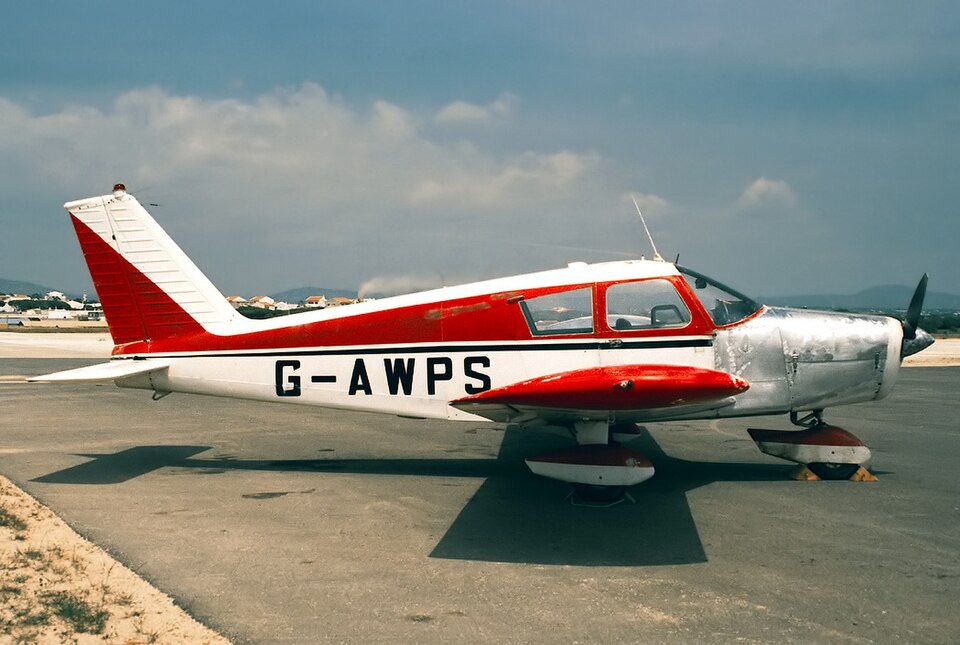
History of the Flight
The flight was planned as an air experience for a couple who knew the pilot through his work. On the morning of the accident, the pilot went to Sittles Airfield, where his aircraft was parked outside and covered in frost. He moved the aircraft to the edge of the landing strip to allow it to defrost in the sun. Later, he telephoned his wife to say the frost was melting and he would be able to fly. The pilot met his passengers at an arranged location and guided them to the airfield. No one else was at the airfield, and there were no witnesses to the takeoff. However, people at an airstrip half a nautical mile north of Sittles Airfield reported seeing the aircraft shortly after takeoff. They said it had taken off in an easterly direction, flown directly overhead their airstrip, performed a couple of maneuvers described as wingovers or stall turns, and then flew away to the west.
Various witnesses near the time of the accident noticed the aircraft climbing steeply or performing a wingover or stall turn before descending. Several saw the aircraft descending steeply or heard a loud, roaring noise before impact. The aircraft hit the ground in a steep nose-down attitude at high speed, and a post-crash fire ensued. The accident was not survivable.
Radar Information
Radar data was provided by NATS from Claxby and Manchester recordings, along with a screen-capture video from Birmingham Airport. All three sources identified G-AWPS at various stages of flight, but only primary returns were recorded, providing no altitude information. The Birmingham recording identified the aircraft near Sittles Farm around 1145 hrs, tracking north toward Roddige, then turning left northwest toward Little Haywood. The final moments from radar showed a right turn south of Little Haywood. Due to poor resolution, detailed analysis of the final stages was not possible. The final recorded radar position at 1153:40 was approximately 150 metres from the accident site.
Aircraft Information
The PA28-140 was originally a two-seat aircraft, but an optional jump seat modification allowed four people to be carried. The most recent weight and balance schedule for G-AWPS, dated 19 June 1991, showed two seats, but wreckage evidence suggested four seats. The aircraft could be operated in Normal Category (max weight 2,150 lb) or Utility Category (max weight 1,950 lb) with more restrictive weight and balance limitations. Utility Category allows certain aerobatic maneuvers: spins, steep turns, lazy eights, and chandelles. The never-exceed speed (VNE) is 168 mph IAS (146 kt), indicated as 171 mph CAS. A weight and balance calculation based on the 1991 schedule, using estimated fuel and occupant weights, showed that if fuel tanks were half full (20 imperial gallons), the aircraft was probably within Normal Category limits but not within Utility limits.
Pilot Information
The pilot obtained his Private Pilot’s Licence (PPL) in 1988 and flew regularly until April 1997, when he purchased G-AWPS. At that time, his logbook recorded 300 hours, mostly from Halfpenny Green Airport, endorsed by annual Certificates of Experience. After purchasing the aircraft, it was based at Tatenhill Airfield until September 1999, then at Sittles Airfield. His personal logbook entries ended in October 1997 after 330 hours. In September 1999, he started a new logbook with a starting value of 800 hours; 47 hours were recorded up to January 2001, with a Certificate of Experience signed on 6 January 2001. That was the final entry, validating his licence until 5 January 2003. No further logbooks were found. Airframe logbooks recorded 64 flight hours between March 2006 and May 2008, likely flown by the pilot. According to CAA records, the pilot’s last medical examination was in 1995, with validity expiring in 1997. One person who had flown with the pilot years earlier described being shown a maneuver: a shallow dive, pull-up to a nose-high attitude, turn with rudder to a nose-down attitude, then recovery from the dive.
Wreckage Examination
The accident site was at Colwich Junction near Little Haywood, Staffordshire. The wreckage was found between two branches of railway track forming part of the West Coast mainline. The initial impact was with an overhead power cable gantry, moving it on its plinth, disrupting the cantilever, and failing the electric cable. First ground marks were scrape marks on a railway track and a significant crater beside the track. Fragmented wreckage was distributed in a westerly splay from the initial impact marks. Parts were recovered up to 60 m from the initial impact point. A fire was localized to parts of the wreckage. A police underwater search team recovered items from the nearby canal.
All major parts were accounted for. The empennage remained relatively intact, with control cables to stabilator, trim, and rudder still connected. No liquid fuel remained on site, but a residual fuel smell was present in some areas. The propeller was found in the impact crater, complete except for the last 10 cm of one blade, which was located a short distance away. Both blades were bent rearwards with chord-wise scratching and indentations, indicating rotation at impact. The engine core was found just outside the crater, substantially damaged; most external components were detached. Parts of a cylinder head and valve gear were found in the crater. No evidence of pre-existing defects was seen, and the wreckage was recovered for detailed examination.
Detailed Wreckage Examination
Flight, fuel, and engine control systems were intact up to impact, with disruptions caused by overload failures. In the fuel system, both wing tanks were ruptured and pulled forward, tearing along riveted joints. Both fuel filler caps were displaced but found among wreckage. A partially full jerry can found near a hangar at Sittles Airfield contained fuel that, upon chemical analysis, was most likely unleaded motor fuel from a petrol station. Several containers of fuel were found in a lock-up store the pilot used at the airfield, and one in his car boot, though it could not be confirmed if intended for the aircraft. There was no evidence that the aircraft was refueled on the morning of the accident.