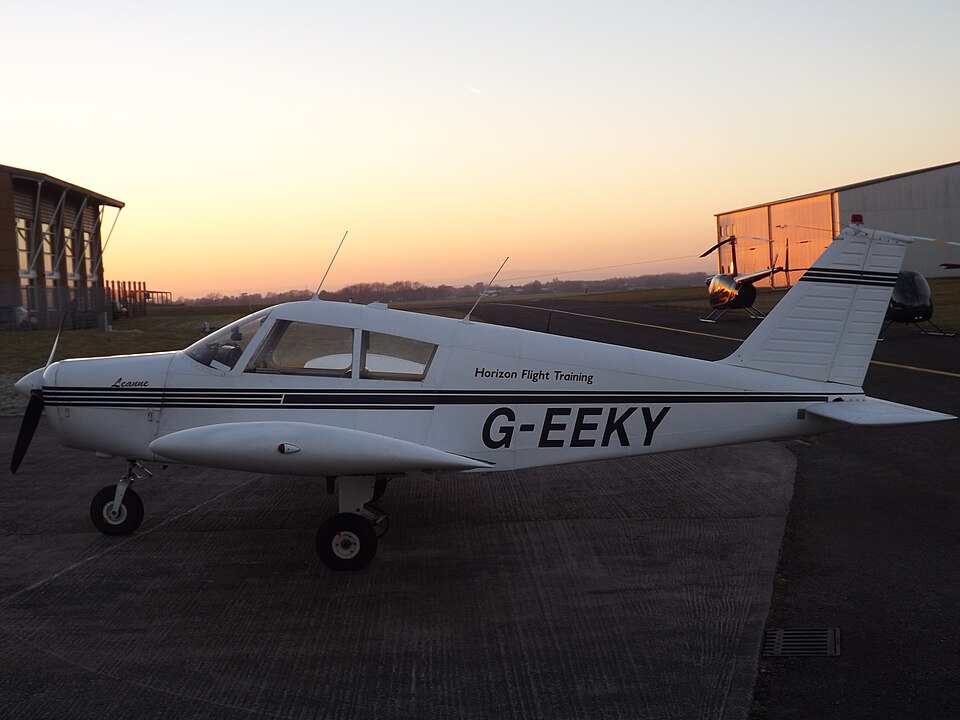
History of Flight
On 5 November 2005, a Piper PA-28-140 (modified) Cherokee, registration G-EEKY, was on a private flight from RAF Marham, Norfolk. At 2,000 ft agl, the pilot set carburettor heat to HOT and retarded the throttle to 1,500 rpm before descending to 1,200 ft. Upon levelling, she selected carburettor heat to COLD and attempted to advance the throttle, but its travel was restricted between closed and half open, limiting engine speed to 1,500 rpm. The aircraft could not maintain level flight. The pilot tried clearing the restriction by turning on the fuel pump, switching fuel tanks, and reselecting carburettor heat to HOT, without success. She conducted a forced landing into a field 5 nm north-west of RAF Marham, while her passenger transmitted a MAYDAY. After touchdown and a ground run of about 30 m, the nosewheel dug into soil, the propeller struck the ground, and the engine stopped. Both occupants vacated uninjured.
Aircraft Damage
Approximately two hours after the accident, the Chief Flying Instructor (CFI) from the flying club at RAF Marham inspected the aircraft. He found a throttle restriction: the lever could only move from half travel to fully open, and retarding from half travel to closed was restricted. The aircraft was examined by a repair agency, which found damage to the underside of the engine cowl, nosewheel, right wing tip, and propeller. The carburettor was pushed against the firewall, but no restriction was found in the throttle linkage from the quadrant to the carburettor. The engine and carburettor were sent for shock-load testing; no cause of restriction was identified.
Weather and Carburettor Icing
An automatic METAR at RAF Marham at 1150 hrs reported surface wind 220°/11 kt, visibility >10 km, temperature +11°C, dew point +6°C. The pilot reported surface wind 230°/15 kt, temperature +11°C, dew point +8°C. An aftercast of these conditions plotted on the Carburettor Icing Chart fell in the 'Serious Icing - Cruise Power' sector. Despite use of carburettor heat in the descent, icing could have formed downstream of the accelerator pump near the discharge valve and nozzle, potentially causing a throttle restriction without rough running.
Analysis
The throttle restriction found by the CFI differed from the pilot's report; it may have resulted from landing damage. However, the repair agency found no mechanical interference. A subtle temporary mechanical restriction or an unusual form of carburettor icing were considered likely. Ice could explain why the pilot could not open the throttle but the CFI could later, though it does not explain why the CFI could not close the throttle on the ground after ice would have melted.
Conclusion
The accident was attributable to a throttle restriction, but the origin of the restriction could not be identified.