Introduction
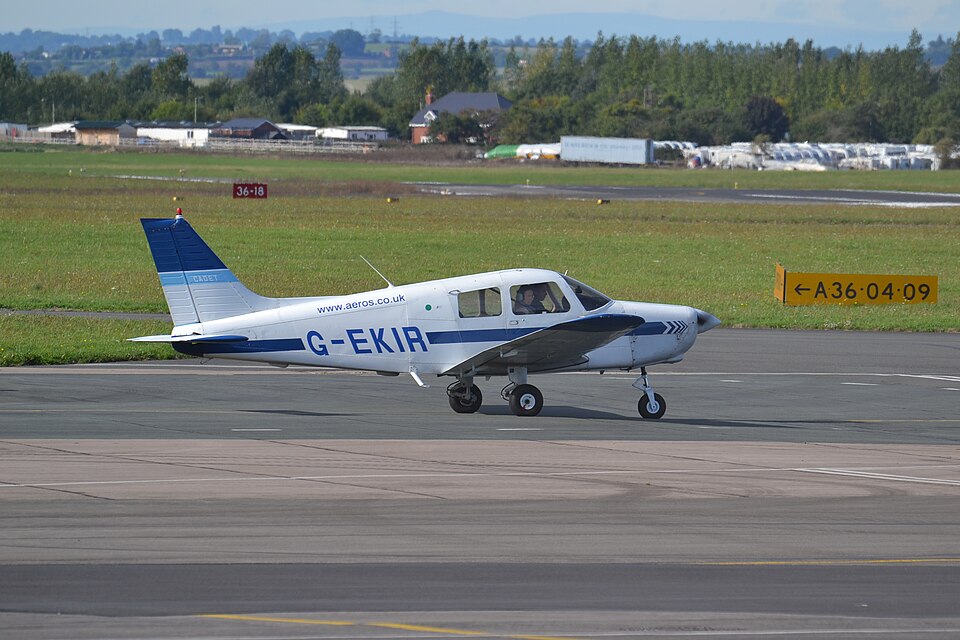
On 16 August 2002 at 1550 hours UTC, a Piper PA-28-161 Cadet (registration G-EKIR) suffered a runway excursion during landing at Welshpool Airfield, Wales. The aircraft was on a private flight from Gloucester. Both crew members were uninjured, but the aircraft sustained damage to both wings.
Aircraft and Crew
The 1989-built Piper PA-28-161 Cadet was powered by a single Lycoming 0-320-D3G piston engine. The commander, aged 35, held a Private Pilot's Licence and had accumulated 121 hours of flying experience, all on type, with 4 hours in the last 90 days and 4 hours in the last 28 days.
Flight Details
Before departing Gloucester, the pilots conducted a brake check. Upon arrival at Welshpool, they were unable to establish radio contact with the tower. Observing that the windsock indicated calm surface wind, they flew a normal circuit for an approach to asphalt Runway 22 (709 x 18 metres). The handling pilot considered the aircraft too high on finals and executed a go-around from the first approach. During the subsequent approach, he again felt high but attributed the impression to the perspective of the short and narrow runway. On short finals, both pilots assessed the aircraft as correctly positioned on the centreline and at the correct speed and height.
Incident Sequence
A normal touchdown was made. As progressive braking was applied, the aircraft began to yaw to the left. The pilot reduced brake pedal pressure, and the aircraft recovered to the runway centreline. When brakes were reapplied, the aircraft again yawed left, and the pilot could not maintain directional control while braking. As the aircraft was about to depart the side of the runway, the pilot retracted the flaps and applied full power in an attempt to take off. With the aircraft now on the grass, he changed his mind and closed the throttle. The aircraft crossed the airfield boundary, passed between two posts of a wire fence — damaging the leading edges of both wings — and came to rest in a small field. The engine was shut down, and both pilots vacated the aircraft uninjured.
Post-Incident Inspection
The aircraft was inspected in situ by the owner and then taxied back onto the airfield under its own power. The brakes were checked and found to operate normally. After recovery to Gloucester, the chief engineer of the flying club's engineering subsidiary performed further checks of the braking system, including dismantling the wheels and brakes, but no faults were found.