History of the Flight
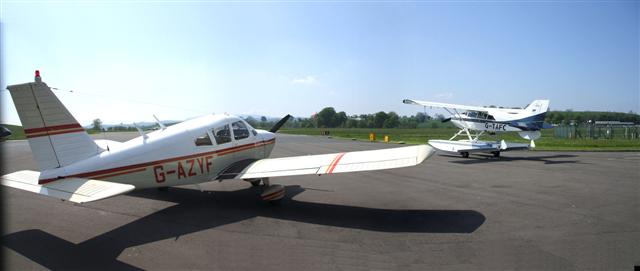
On 3 July 2006, a Piper PA-28-180 Cherokee, registered G-AZYF, departed Land's End Airport for a private flight to Scilly Isles (St Mary's) Airport. The aircraft, manufactured in 1968 and powered by a single Lycoming O-360-A4A piston engine, was flown by a 66-year-old pilot holding a Private Pilot's Licence with 350 hours total flying experience (197 on type). One passenger was on board.
Runway 09 at St Mary's was in use. The runway is 523 m in length with a grass and asphalt surface that was dry; the first 250 m is grass, followed by 273 m of asphalt. The first 100 m of Runway 09 rises at a 1:20 gradient (5%). The weather was CAVOK with wind from 040° at 15 kt, described as "blustery".
After an uneventful transit, the pilot positioned the aircraft downwind for Runway 09. At the end of the downwind leg, air traffic control instructed him to perform one right-hand orbit to increase separation from another aircraft approaching Runway 09. Following the orbit, the pilot reversed the turn and rolled out on final approach. He realised he was slightly south of the extended centreline and closer to the runway than desired; the aircraft was slightly high and fast, but the pilot felt "comfortable". He had extended two stages of flap, his normal landing configuration, but elected to deploy a third stage to slow down and descend.
The Accident
Knowing the runway was relatively short, the pilot aimed to land close to the threshold. He touched down at approximately 75 kt, about 5 kt fast and "a little heavy", near the threshold. The aircraft rolled for about two seconds before striking a small ridge or pot hole on the grass surface and became airborne again, reaching approximately 5 ft above ground level. The nose dropped quickly, and the pilot could not raise it before the aircraft landed on its nosewheel. The nose leg collapsed, and the propeller struck the ground. The pilot could not recall whether the aircraft bounced more than once. The air traffic controller in the tower, about 120 m away, reported seeing the aircraft bounce "two or three times" to a height of approximately 10 ft. After the last bounce, the aircraft was in a nose-low attitude before landing. After landing, the aircraft veered right and continued down Runway 18, which has a grass surface, before coming to rest just off the edge of Runway 18. The pilot and passenger vacated the aircraft uninjured.
Damage Assessment
Inspection by the repair agency revealed damage to the nose leg, nosewheel fairing, propeller, engine mount, and heater box. The engine had been shock-loaded.
Discussion
As a result of the crosswind, the aircraft ended up south of the runway's extended centreline. The pilot reported, in hindsight, that he should have re-positioned the aircraft for another approach. He noted that with the third stage of flap selected, he ended up on a very steep and fast approach, descending "like an express lift." As a consequence of the slightly fast landing and striking an uneven part of the grass runway during the landing roll, control of the aircraft was momentarily lost before it landed heavily on its nose gear.