No fatalities

Piper PA-28-181 Overruns Runway at Leicester Airport (G-BPAY)

Leicester Airport, Leicestershire, GB

On December 27, 2004, a Piper PA-28-181 Cherokee Archer II (registration G-BPAY) operated by White Waltham Airfield Ltd was involved in an aviation accident near Leicester Airport, Leicestershire, GB. No fatalities were reported. Investigators recorded the probable cause as: The pilot used only two of the three stages of flap and touched down at an abnormally high speed; he indicated that the primary reason was his expectation of landing on Runway 28, having not used other runways at Leicester for over a year. This summary draws on records from the UK Air Accidents Investigation Branch (AAIB).

Sourcesthe UK Air Accidents Investigation Branch (AAIB)Primary reportUpdated 2026-10-18Data APIEditorial standards
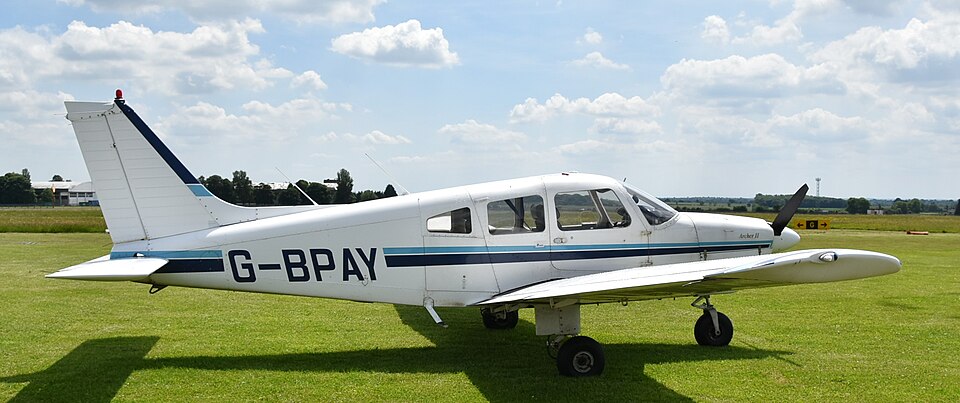
Aircraft registered G-BPAY
Aircraft registered G-BPAY. Photo: Alec Wilson from Khon Kaen, Thailand / CC BY-SA 2.0, via Wikimedia Commons

A Piper PA-28-181 overran Runway 22 at Leicester Airport after the pilot, expecting Runway 28, touched down fast with insufficient flap. No injuries occurred.

History of the Flight

On 27 December 2004, a Piper PA-28-181 Cherokee Archer II (registration G-BPAY) operated a private flight from Wellsbourne Airfield to Leicester Airport. The pilot, a 60-year-old with 165 total flying hours (10 on type), expected to land on Runway 28, which had been in use at departure. However, the duty runway had been changed to Runway 22, which is 490 metres long by 30 metres wide, compared to Runway 28's 940 metres by 30 metres.

The pilot joined the overhead for a left-hand circuit. On the downwind leg, he lowered one stage of flap, and a second stage on base leg. The surface wind was from 220° at 5 to 10 kt, visibility 15 km, with scattered cloud at 3,000 feet. At about half a mile from the runway threshold, the pilot realised he was too low and added power, which increased his approach speed from 65 kt to 75 kt.

The aircraft touched down near the threshold. Upon applying wheel brakes, the pilot felt the tyres skidding on a slippery surface. He released and reapplied the brakes several times to improve braking. The aircraft overran the end of the runway into a ploughed field, causing the landing gear to collapse and the propeller to strike the ground, stopping the engine.

The pilot carried out emergency drills, and he and his passenger vacated normally. Airport Rescue and Fire Fighting attended promptly.

Conclusion

The pilot had used only two of the three available stages of flap, and the aircraft's speed was abnormally fast on touchdown. He believed the main reason for the accident was his mental picture of landing on Runway 28, as he had not used any other runway at Leicester for over a year. Runway 22 is 450 metres shorter than Runway 28, and the pilot considered that the accident might have been avoided if he had varied his experience by using other runways.

Remarks

This aircraft had previously overrun the available length of Leicester's Runway 22 on 23 July 2001, at the conclusion of an abnormally fast approach, having touched down half way along the runway.

Probable cause

The pilot used only two of the three stages of flap and touched down at an abnormally high speed; he indicated that the primary reason was his expectation of landing on Runway 28, having not used other runways at Leicester for over a year.

Frequently asked questions

What happened in the 27 Dec 2004 Piper PA-28-181 Cherokee Archer II accident near Leicester Airport, Leicestershire, GB?

A Piper PA-28-181 overran Runway 22 at Leicester Airport after the pilot, expecting Runway 28, touched down fast with insufficient flap. No injuries occurred.

Were there any fatalities in the 27 Dec 2004 Piper PA-28-181 Cherokee Archer II accident?

No fatalities were recorded in this accident.

What aircraft was involved and where did it happen?

The accident on 27 Dec 2004 involved a Piper PA-28-181 Cherokee Archer II, registration G-BPAY, operated by White Waltham Airfield Ltd, at Leicester Airport, Leicestershire, GB.

What was the probable cause of the accident?

The pilot used only two of the three stages of flap and touched down at an abnormally high speed; he indicated that the primary reason was his expectation of landing on Runway 28, having not used other runways at Leicester for over a year.