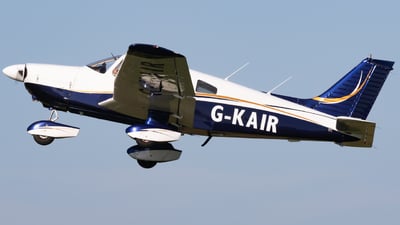
History of Flight
The aircraft, a Piper PA-28-181 registered G-KAIR, departed Cumbernauld Airport on 7 July 2002 at 1710 UTC for a private flight to Aldergrove for routine maintenance. A few minutes into the flight, the engine began to run roughly. The pilot turned back towards Cumbernauld. When approximately six miles from the airfield, the cockpit filled with smoke. The smoke seriously impaired the pilot's vision and caused considerable discomfort, prompting him to open the door in an attempt to clear it. He radioed the airfield requesting that all circuit traffic be cleared, as he intended to make a direct downwind approach to Runway 08 to minimise exposure to the fumes.
Upon landing, the pilot applied heavy braking, causing the aircraft to slew from side to side. The right main wheel tyre burst as a result. The pilot taxied clear of the runway and onto the apron before shutting down the engine. Airfield personnel arrived almost immediately and discharged CO2 and powder fire extinguishant into the engine compartment, which was emitting smoke. The pilot was taken to a local hospital where he was detained overnight and treated for the effects of smoke inhalation. He sustained minor injuries.
Examination of the Aircraft
A local maintenance engineer and a CAA surveyor examined the aircraft. They noted that the edges of both front cylinder baffles had been protected by a bead of black RTV sealant, a high-temperature silicone compound, to prevent erosion by the cylinder cooling fins. However, the bead on the baffle adjacent to the No. 2 cylinder had become detached. The air intake for the exhaust heat exchanger of the cabin heater was located in the baffle immediately ahead of where the bead had been.
Fragments of the beading were recovered and found to smoulder when an attempt was made to burn them. The pilot identified the odour of the fumes produced as similar to those encountered in flight. It was concluded that fragments of RTV sealant had fallen into the cabin air heat exchanger, and that the cabin heat control had not been completely closed.
The rough running was attributed to two spark plugs which were found to be worn almost to their limits.
Subsequent Action
Although the use of RTV sealant was not required in the maintenance procedures, it had become accepted practice to prevent baffle erosion. Following the incident, the maintenance organisation responsible for the aircraft stopped this practice.