History of the Flight
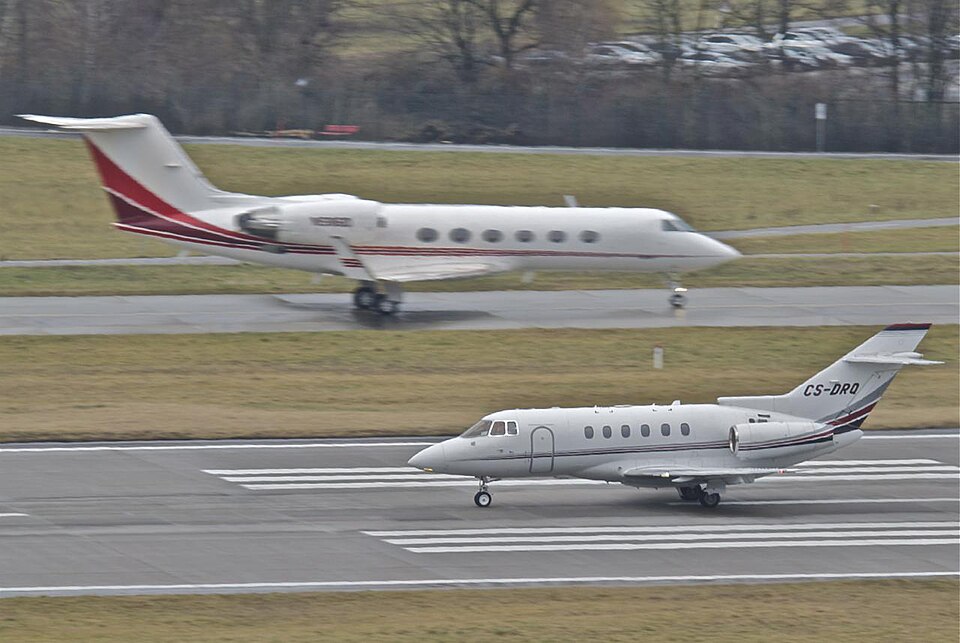
On 31 October 2006, a Raytheon Hawker 800XP (registration CS-DRQ) was preparing for a non-revenue commercial flight from London City Airport (LCY) to Brussels. While stopped at holding point Mike (Hold M) for Runway 28, the crew observed red flags on both Primary Flight Displays (PFDs) for attitude and heading, indicating that the Attitude and Heading Reference System (AHRS) had failed and heading indications were unreliable. The pilots noted this was a known fault at LCY, which they attributed to metal in the taxiway pilings. After lining up on Runway 28, the flags disappeared without action. However, after departure, the pilots could not control the aircraft in heading using the autopilot; the heading selector bugs did not respond. A 60-degree difference appeared between the two PFD headings, and the standby instrument showed a heading 15 degrees less than PFD 1. Both flight directors were unavailable. Following the Quick Reference Handbook emergency procedures, the crew selected AHRS 1 as the source for both flight instruments, but the system did not return to normal for another 10 minutes. They requested radar vectors and returned to LCY, landing without incident.
Previous Occurrences
The AAIB learned of similar incidents dating from January 2000. These involved several aircraft types, including Hawker 800, Cessna Citation, and Fokker 50, all experiencing navigation problems after departure from Runway 28 at LCY. Early occurrences with Fokker 50 aircraft were attributed to poor compliance with assigned routings. A series of reports beginning in October 2004 included: CS-DNK (Hawker 800) on 26 October 2004, where a discrepancy was noted between compasses; CS-DNX (Hawker 800) on 10 March 2005, with temporary loss of heading information; CS-DXE (Cessna C560 Citation XL) on 28 February 2006, where all three compasses became unserviceable while parked at Hold M; and CS-DMA (Beech 400A) on 6 November 2006, where a compass comparator warning appeared. Pilots of CS-DMA reported difficulty following the assigned SID for 28 minutes. Initial investigation by the CAA ruled out the LON VOR as the cause.
Engineering Investigation
An AAIB Inspector with a hand-held compass found large magnetic anomalies in the Runway 28 holding area, causing deviations up to ±60 degrees. QinetiQ engineers conducted magnetic signature and compass deviation surveys. The surveys identified areas where the magnetic field was so strong that a compass needle pointed vertically, preventing a reading. The anomalies were attributed to remaining railway lines from the site's previous use as a dock, flame-cut cast iron bollards, and steel-encased concrete piles supporting the holding area. The steel casings were from a disused oil pipeline. QinetiQ concluded that the magnetic anomalies were sufficiently severe to explain the reported compass deviations. Refurbishment of the taxiway revealed that the original steel reinforcement nets had permanent magnetism, unlike modern materials.
Outcome
The AAIB made six Safety Recommendations. The cause of the problem was identified as strong magnetic anomalies in the holding area for Runway 28 at London City Airport.