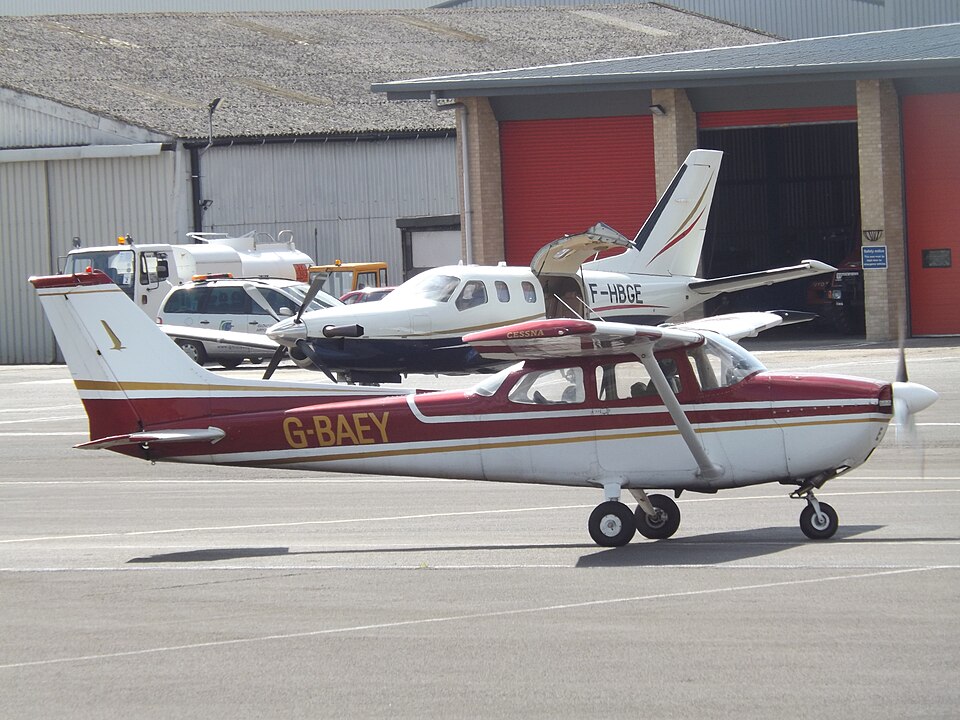
History of the Flight
On 18 April 2006, the pilot of G-BAEY, a Reims Cessna F172M Skyhawk, intended to conduct an aerial photography flight that would involve carrying a passenger. Because the pilot had not flown a single-engine piston aircraft in the previous 90 days, he was required to perform three takeoffs and landings to meet recency requirements before carrying passengers. The pilot planned to fly circuits alone on Runway 28 at Conington Airfield, where the aircraft was based.
The flight was observed by another pilot from the ground, referred to as the “Senior Pilot.” Witnesses reported that the first circuit was uneventful until the landing, during which the aircraft bounced several times before going around for another circuit. The pilot recalled that during the second circuit, after a stable final approach, he flared for landing. At that point, the nose pitched up unexpectedly beyond the normal landing attitude. In response, he pushed forward on the control yoke to prevent a stall. The aircraft then touched down heavily on its nosewheel.
The nose landing gear partially collapsed, allowing the propeller tips to contact the runway. Despite the damage, the uninjured pilot taxied the aircraft to a parking position. After the accident, the pilot expressed concern about a possible control restriction but was reassured when told the aircraft had flown without incident since its recent maintenance. The pilot also suggested that a sudden change in wind direction and strength might have caused the pitch-up.
Damage to Aircraft
The nose landing gear was displaced laterally and vertically, consistent with a high rate of descent on touchdown. Upward displacement of the instrument panel trapped the shafts of both control yokes, which were in a nose-down elevator position. Ripples in the fuselage skin and upward displacement of the cabin floor indicated a very heavy landing.
Aircraft Information
The Cessna 172 is a high-wing single-engine aircraft with tricycle landing gear, designed to touch down on its main wheels. The nose landing gear provides steering and stability but is not designed to absorb the first impact of landing. The aircraft had returned to service on 12 April 2006 after an annual inspection and had flown uneventfully until the accident. The maintenance organization had no record of pre-existing mechanical defects.
Meteorological Information
The surface wind reported by the AFIS was from 260° at 15 kt, with visibility of 10 km or greater and scattered cloud at 4,000 ft. The pilot reported actual wind varying between 260° and 290° at 15 kt, resulting in a maximum crosswind component of approximately 5 kt. Local topography is not noted to produce unusual winds or turbulence, and no adverse weather conditions were reported. The runway surface was dry.
Pilot Information
The pilot held a Commercial Pilot’s Licence, was 35 years old, and had 485 total flying hours, with 90 hours on type. His recent flying experience was in a jet transport simulator, and he had not flown a single-engine piston aircraft in the previous 90 days. His last 90 days included 22 flying hours, with 7 hours in the last 28 days.
Previous Occurrences
A review of AAIB bulletins revealed similar occurrences where unstable approaches led to abrupt nose-lowering attempts, resulting in damage to nose landing gear and propellers. These events were not limited to a specific aircraft type.
Conclusion
The available evidence indicated the aircraft was serviceable before the accident, and weather conditions were unlikely to have affected the flight adversely. The aircraft touched down on its nosewheel, subjecting the nose landing gear to loads exceeding its design strength, causing it to fail. The control yoke shafts were trapped when the loads deformed the cockpit floor and instrument panel.