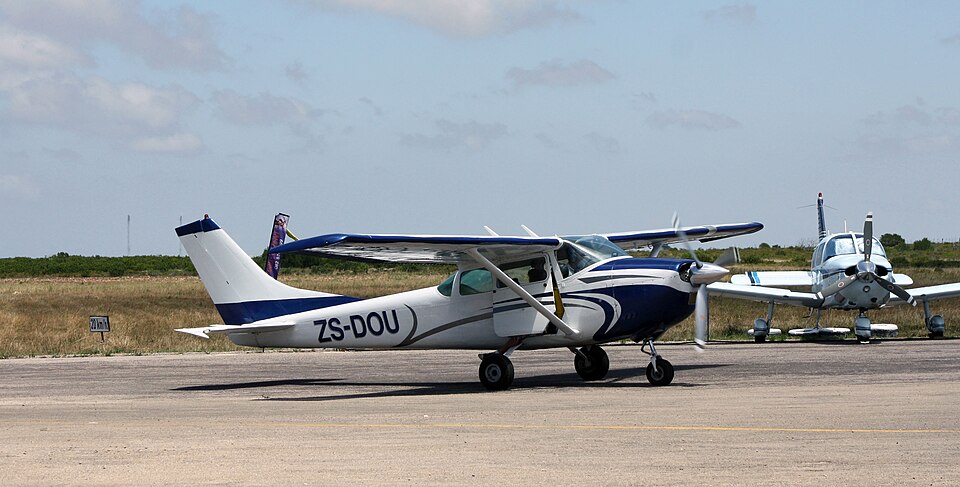
History of the Flight
On 12 September 2015, at approximately 1115Z, a Cessna 182 F, registration ZS-DOU, was operating a commercial skydiving flight under visual flight rules (VFR) by day. The flight departed from Mossel Bay Airport (FAMO) in the Western Cape Province. The pilot, a 31-year-old commercial pilot with 693.6 total flying hours, including 247.2 hours on type, climbed to flight level FL105, where the skydivers jumped. After about 30 minutes aloft, the pilot began a descent back to FAMO.
At an altitude of about 9000 feet, while descending toward FAMO, the engine began running roughly. The pilot immediately applied carburettor heat, suspecting carburettor icing. The engine briefly returned to normal operation but then again ran roughly and eventually stopped completely. The aircraft was at approximately 3000 feet, about 2 nautical miles from FAMO. The pilot attempted to glide to the airport but realized he would not make it and chose to execute a forced landing in an open field approximately 2 nautical miles southwest of Runway 10 at FAMO (GPS coordinates 340954S 0220243E).
The pilot landed the aircraft, but during the landing roll, the nose wheel entered an irrigation ditch, causing the aircraft to flip over onto its roof. The pilot was not injured. The aircraft sustained substantial damage.
Injuries to Persons
There were no injuries. The pilot was the only person on board.
Damage to Aircraft
The aircraft sustained substantial damage.
Personnel Information
The pilot held a valid Commercial Pilot Licence with ratings for Instrument, Instructor, Night, and Single/Multi Engine Piston. His medical certificate was valid until 31 January 2016. He had 247.2 hours on type, all within the past 90 days. A previous accident on 22 October 2014 involved an engine stoppage due to a fuel leak.
Aircraft Information
The aircraft was a Cessna 182 F (serial number 182-54904), manufactured in 1963. The total airframe hours at the time of the accident were 7655.4. The last maintenance inspection (MPI) was on 21 August 2015 at 7618.3 hours, with 37.1 hours since. The engine was a Continental O-470 U (serial number 827634-R), with 7655.4 hours since new and 139.4 hours since overhaul (overhaul completed 12 December 2014). The propeller was a Hartzell PHC-G3YF-1RF (serial number NT182B), 139.4 hours since new. The aircraft was operated under Part 91 (commercial).
Meteorological Information
The pilot reported wind 100° at 10 knots, temperature 20°C, dew point unknown, sky clear, visibility good. The nearest weather station at George Airport (FAGG) issued a METAR showing wind 170° at 7 knots, temperature 16°C, dew point 12°C, scattered clouds at 3000 feet, visibility 9999 meters.
Engine Failure and Carburettor Icing
Post-accident investigation included a review of engine maintenance records. The engine had previously been removed after a propeller strike in 1986 and underwent a shock load inspection; it was returned to service. In 2014, the engine was overhauled and operated without defects. Fuel examination showed no anomalies: 70 litres at takeoff, 40 litres remaining. The aircraft was within weight and balance limits.
The pilot expressed concern about carburettor icing. Investigation using carburettor icing probability charts indicated that conditions were favorable for carburettor icing at the time. The pilot had not checked temperature and dew point before the flight and had not used carburettor heat according to the aircraft flight manual procedures to prevent icing. The engine was dismantled, cleaned, and inspected; no mechanical defects were found.