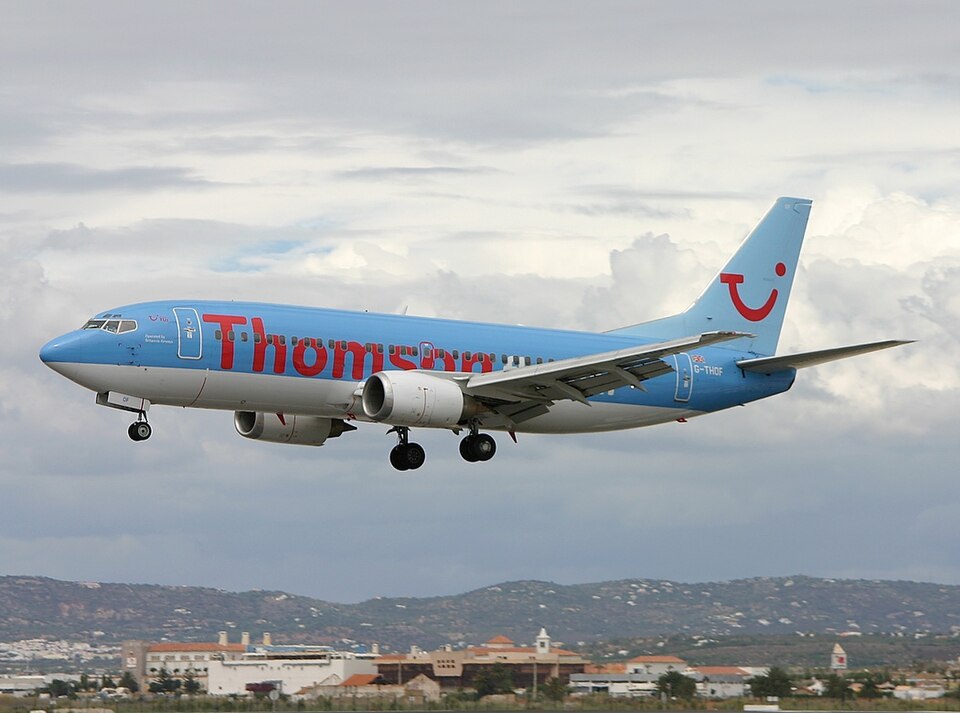
Synopsis
On 23 September 2007, at 2250 hours UTC, a Boeing 737-3Q8, registration G-THOF, operated by Thomsonfly Ltd, was on approach to Runway 26 at Bournemouth Airport, Hampshire, following a routine passenger flight from Faro, Portugal. The incident was reported by the operator to the Air Accidents Investigation Branch on 5 October 2007, twelve days after the event.
Details
Early in the instrument landing system (ILS) approach, the auto-throttle disengaged with the thrust levers in the idle thrust position. The disengagement was neither commanded nor recognised by the crew. The thrust levers remained at idle throughout the approach. As the aircraft was fully configured for landing, the airspeed decayed rapidly to a value below that appropriate for the approach. The commander took control and initiated a go-around. During the go-around, the aircraft pitched up excessively; flight crew attempts to reduce the aircraft’s pitch were largely ineffective. The aircraft reached a maximum pitch of 44° nose-up and the indicated airspeed reduced to 82 knots. The flight crew recovered control and completed a subsequent approach and landing at Bournemouth without further incident.
Findings
The investigation identified the following causal factors:
- The aircraft decelerated during an instrument approach to an airspeed significantly below the commanded speed, with the engines at idle thrust. Despite the application of full thrust, the aircraft stalled, after which the appropriate recovery actions were not followed.
- The trimmed position of the stabiliser, combined with the selection of maximum thrust, overwhelmed the available elevator authority.
Contributory factors included:
- The autothrottle warning system, although working as designed, did not alert the crew to the disengagement of the autothrottle system.
- The flight crew did not recognise the disengagement and allowed the airspeed to decrease 20 knots below Vref before recovery was initiated.
- The pilots were distracted at a critical phase of flight and did not properly monitor the airspeed.
- The constant deceleration approach masked the autothrottle disengagement.
- The stall recovery techniques recommended in the manufacturer’s Flight Crew Training Manual were not fully applied.
- Forward trim was not used during the stall recovery.
- The aircraft stalled and descended in a nose-up attitude, slowing to a minimum airspeed of 82 knots.
- The thrust levers remained at full thrust for 26 seconds, with N1 exceeding the target for 31 seconds.
- The go-around drill and approach to stall drill in the Quick Reference Handbook do not mention trimming the aircraft.
Safety Recommendations
Three safety recommendations were made:
- Safety Recommendation 2009-043: Boeing, in conjunction with the FAA, should conduct a study of the efficacy of the Boeing 737-300/400/500 autothrottle warning and take steps to improve crew alerting.
- Safety Recommendation 2009-044: EASA should review Certification Standard 25 requirements to ensure that disengagement of autoflight controls including autothrottle is suitably alerted.
- Safety Recommendation 2009-045: Boeing should clarify the wording of the approach to stall recovery Quick Reference Handbook Non-normal Manoeuvres to ensure pilots are aware that trimming forward may be required.