Flight History
On Monday, 13 August 1973, at 1718 hours MEZ, the pilot departed the glacier landing site Mutthorn-Hütte on a commercial flight to Bern. On board was a passenger residing in Häutligen. During the flight, the passenger requested to be set down in Häutligen, and the pilot agreed, intending to land on a meadow owned by the passenger. Over Häutligen, the pilot made two reconnaissance circles and observed heavy harvest activity on the intended landing area. He then decided to land on a higher meadow approximately 213 meters in length. He flew directly toward this meadow without the required reconnaissance. While turning into the landing approach, the pilot had to increase engine power slightly to clear a high-voltage power line that crossed the landing direction (360–010°) directly in front of the field.
The aircraft touched down about 120 meters after crossing the power line on rising terrain bounded by a forest. With only about 93 meters of rolling distance available before the forest edge, the pilot attempted to veer to the right but failed. At 1740 hours, the left wing struck a fir tree, causing the aircraft to turn left and come to rest with the engine still running among the trees.
Damage and Injuries
The occupants were uninjured. The aircraft sustained heavy damage, and light crop damage occurred.
Pilot and Aircraft
The pilot, born in 1923, was a glacier pilot holding a limited professional pilot license. His total flight experience was 6,241 hours, with approximately 5,000 hours on the accident type. In the preceding 90 days, he had flown about 100 hours, all on the accident type. The preliminary investigation found no evidence of any health issues at the time of the accident. The pilot had consumed some alcohol before the flight; a blood test taken at 2030 hours showed less than 0.05‰ alcohol by weight. The pilot's flight operations manual prohibited alcohol consumption eight hours before duty and during the entire duty period.
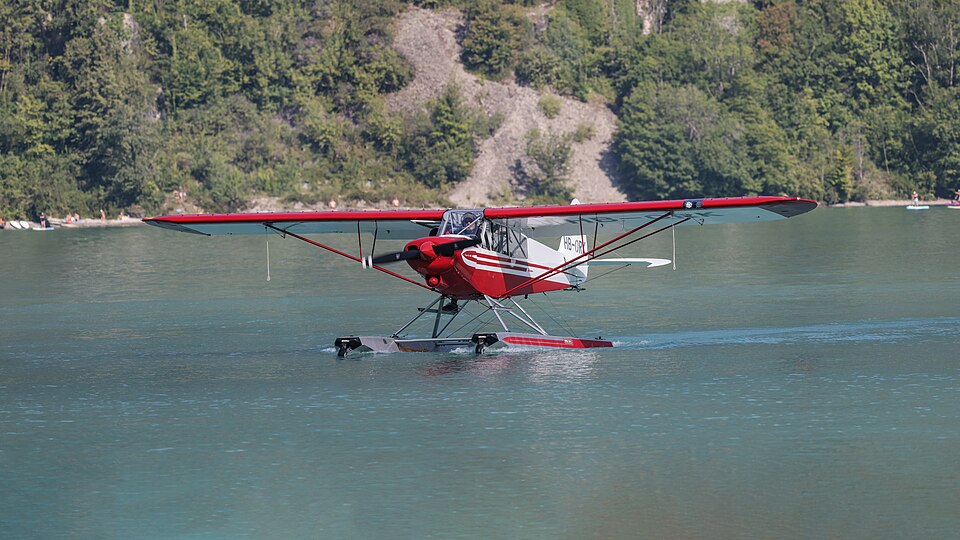
The aircraft, a Piper Super Cub PA-18-150 with registration HB-ORK, held a valid airworthiness certificate. Weight and balance were within limits at the time of the accident. No pre-existing technical defects were found.
Weather
At the time of the accident, the weather in the area was: 1/8 to 2/8 cumulus clouds with base at 2000 meters above mean sea level; visibility 10 to 15 kilometers; wind from northeast at approximately 5 knots; sun azimuth 268° and elevation 22°.
Assessment and Cause
The pilot had insufficiently reconnoitered the selected landing area. Had he done so, he would have realized that clearing the high-voltage power line crossing the approach direction required a relatively high approach. Consequently, the aircraft touched down about 120 meters after the line, leaving only 93 meters of roll-out distance to the forest edge—insufficient to stop. A go-around was not possible under the circumstances.
The probable cause is collision with obstacles during an off-airport landing on unsuitable terrain.