Summary
On 26 September 1961 at 0407 GMT, a Swissair Caravelle SE-210, registration HB-ICW, departed London on flight SR701 to Zurich. The aircraft carried 24 passengers and a crew of five (two pilots, one purser, two hostesses). Due to ground fog at Zurich, the captain diverted to Basel-Mulhouse and conducted an ILS approach to runway 16.
The Approach
Weather at Basel-Mulhouse deteriorated during the approach. At 0510, fog began forming; prevailing visibility fell to 1000 metres at 0512, 500 metres at 0514, and 250 metres at 0516. The crew reported no visual contact with the runway when reaching the minimum descent altitude of 200 feet above ground at the middle marker. The captain momentarily looked for the runway himself, during which the aircraft inadvertently descended.
Ground Contact
At approximately 0517, while still about 125 metres short of the runway threshold and 125 metres right of the extended centreline, the aircraft struck a road (the former C.D.12 bis) running perpendicular to the runway. The road had small embankments and a ditch. The impact tore off the right main landing gear. No injuries occurred among the 24 passengers and five crew. Minor third-party damage on the ground was reported.
Landing at Geneva
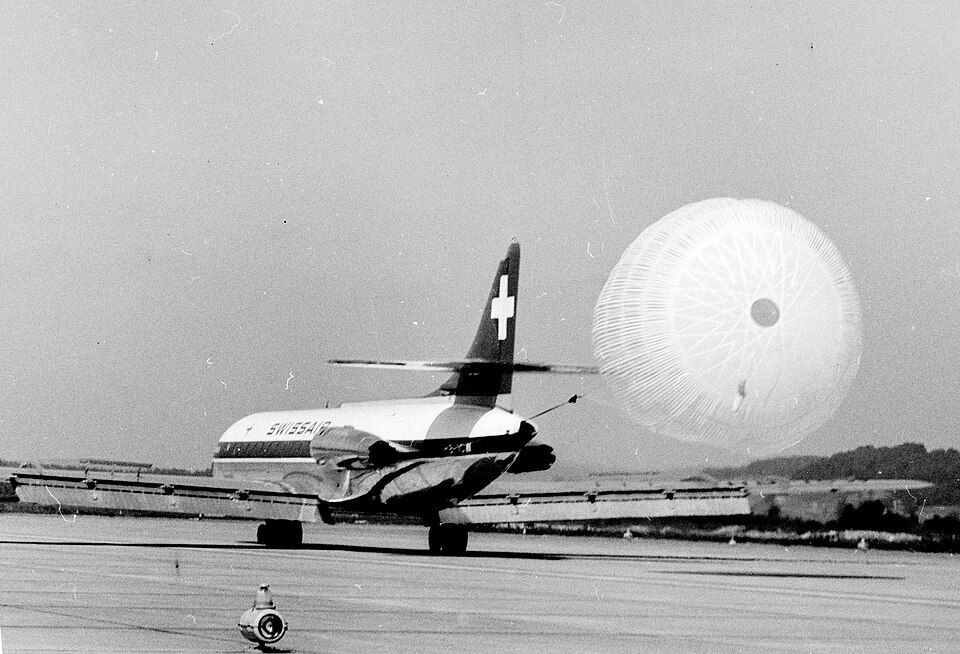
After the ground contact, the crew executed a go-around. They diverted to Geneva-Cointrin, landing on runway 23 at approximately 0721. Due to the missing right main gear, further damage occurred during landing. The captain used the brake parachute. Weather at Geneva remained good with visibility of 7 km and scattered clouds.
Investigation
The investigation was conducted by French authorities for the Basel phase and by Swiss authorities for the Geneva landing. The aircraft was equipped with a flight recorder and radio communications were recorded, which aided the inquiry. Both pilots provided full accounts. No technical defects were found in the aircraft or its instruments. The crew was properly qualified and rested. The aircraft weight and centre of gravity were within limits.