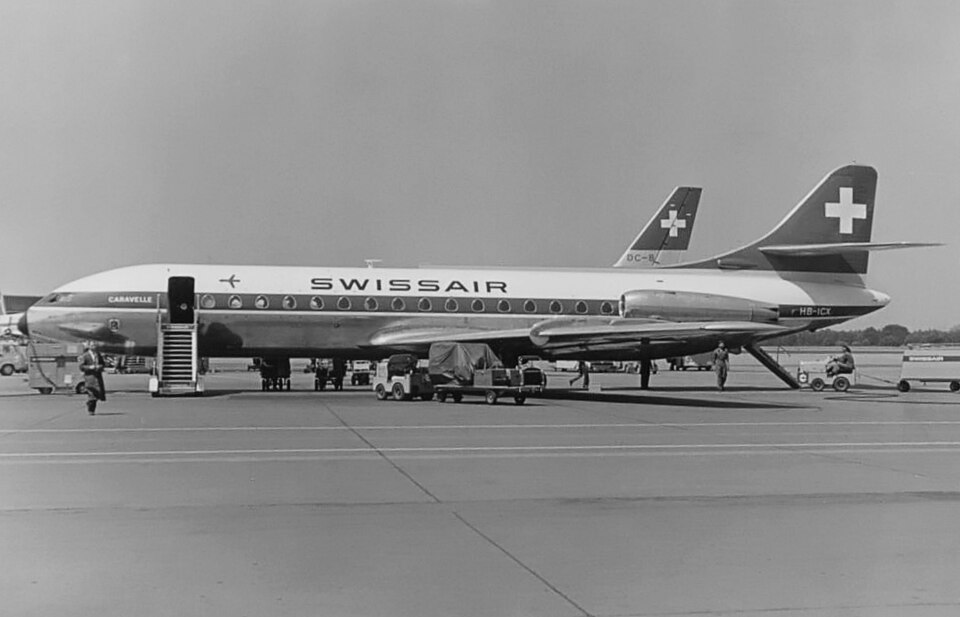
Accident Summary
On Thursday, 30 January 1964, at 2106 MEZ, a Sud-Aviation SE-210 Caravelle III, registration HB-ICX, operated by Swissair as flight 101 from London, landed on runway 16 at Zurich-Kloten Airport. The runway was covered with a thin layer of wet snow. On board were 44 passengers and seven crew members. The approach and landing were normal in light snowfall and variable crosswinds. After a landing roll of approximately 800 meters, the aircraft veered left, struck four runway lights, and sustained damage to its landing gear. It came to a stop on the runway. No injuries occurred.
Sequence of Events
The flight crew consisted of a captain, a captain-in-training (who was flying the aircraft), and a copilot. The crew received a braking action report of "Medium" with 5 mm of wet snow. During the final approach, the captain (captain-in-training) was flying, with the captain in the copilot's seat. At 2105 MEZ, the air traffic controller noted gusty winds and transmitted a wind reading of 230 degrees at 12 knots gusting to 16 knots. This message was not received by the pilots; the copilot, who heard it, did not alert them. The aircraft touched down about five meters left of the centerline and initially tracked straight. After about 850 meters of roll, the aircraft began to yaw left. Despite full rudder, braking, and nosewheel steering input, the crew could not prevent the aircraft from approaching the left edge. The aircraft overran four runway lights between the taxiway 7 junction and the west runway intersection, damaging the nosewheel steering and the right main landing gear. The crew then struggled to prevent a right veer, stopping hard on the right edge at the intersection with the bisecting runway after a total rollout of 1,915 meters.
Weather Conditions
At the time of the accident, light snowfall was occurring with a temperature near 0°C. The wind was from 230 degrees at 13 knots, with gusts up to 16 knots. The runway had a layer of wet snow a few millimeters thick.
Damage
The aircraft's landing gear was damaged in the collision with the runway lights, resulting in approximately 60,000 Swiss francs in repairs and a 36-hour service interruption. Four runway lights were destroyed, valued at about 3,600 Swiss francs. Flight data recorder analysis showed a maximum braking coefficient of 0.19 during the rollout.
Probable Cause
The veering was due to the aircraft, while rolling out on the runway made slippery by snowfall, encountering unexpectedly strong crosswind gusts.