Background
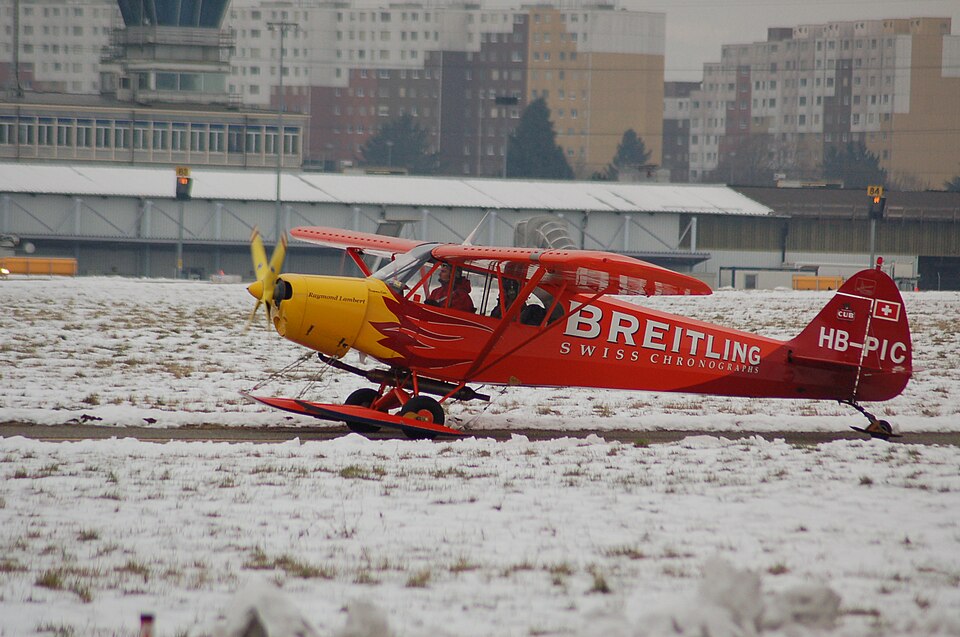
On 22 June 2003, at approximately 18:45 UTC, an airprox (near collision) occurred at Geneva Airport involving two aircraft: SWR9045, a BAe Avro RJ1H (registration HB-IXP) operated by SWISS on a scheduled flight from Geneva to Zürich, and HB-PIC, a Pa18 (Pilatus PC-6 Porter) conducting a private VFR flight around Lake Geneva. The VFR flight had departed from Geneva's grass runway 05 at 18:08 UTC and was returning.
Incident Sequence
At 18:36 UTC, the pilot of HB-PIC contacted Geneva Tower on frequency 118.7 MHz, reporting at the VFR reporting point Echo at 3000 ft. The controller cleared the aircraft to proceed to Sierra Echo, with runway 05 grass in use and QNH 1011 hPa. Subsequently, the pilot requested a 360-degree turn over the Geneva harbor, which was approved over Golf Echo.
Meanwhile, SWR9045 was cleared to line up and wait on runway 05. At 18:45:06, the HB-PIC pilot reported completing the 360. The controller then cleared HB-PIC to overfly the threshold of runway 05 (concrete) to join left downwind for the grass runway 05, as number one. The pilot correctly read back this clearance. However, instead of heading toward runway 05, the Pa18 continued on a heading of approximately 320 degrees, converging on the threshold of runway 23.
At 18:45:22, SWR9045 was cleared for takeoff on runway 05. At that moment, HB-PIC was 0.5 NM east of Golf Echo on a northwesterly heading. The controller did not issue any traffic information to either pilot. SWR9045's pilot detected the conflicting traffic during climb at about 2300 ft; the Pa18 was at approximately 3000 ft. At 18:46:39, the controller asked if the HB-PIC pilot had the departing traffic in sight, to which he replied affirmatively. The controller then reminded the pilot that he had been cleared to overfly the threshold of runway 05. The pilot acknowledged that he was overflying the threshold of runway 23 and apologized.
Radar data showed the closest point of approach at 18:46:44, with a horizontal separation of 0.1 NM and a vertical separation estimated by the SWR9045 pilot as 200 ft (radar data indicated SWR9045 at 2300 ft, with the Pa18 presumed at 3000 ft, giving a maximum vertical separation of 700 ft). No TCAS or Short Term Conflict Alert (STCA) was possible because HB-PIC lacked a transponder and appeared only as a primary radar target without altitude information. The SWR9045 pilot reported having insufficient time to take evasive action.
An Air Traffic Incident Report (ATIR) was filed by ATC, and an Air Safety Report was filed by SWISS. Both the controller and the SWR9045 pilot stated they would file reports.
Established Facts
- Runway 05 was in use at Geneva, with the grass runway open to VFR traffic.
- The aerodrome controller held a valid license.
- Communications with SWR9045 were in English; with HB-PIC, in French.
- In the 18 minutes prior, 17 aircraft were controlled on 118.7 MHz, including 8 departures, 6 arrivals, and 3 VFR flights.
- HB-PIC appeared on radar only as a primary synthetic track, with no altitude readout.
- The controller did not continuously monitor HB-PIC's track, citing high traffic load, and noticed the deviation too late.
- The HB-PIC pilot stated he did not realize SWR9045 was in its takeoff roll because he did not understand English communications.
Cause
The incident was due to the non-application, by the pilot of an aircraft flying under visual flight rules, of an ATC clearance that he had correctly read back.