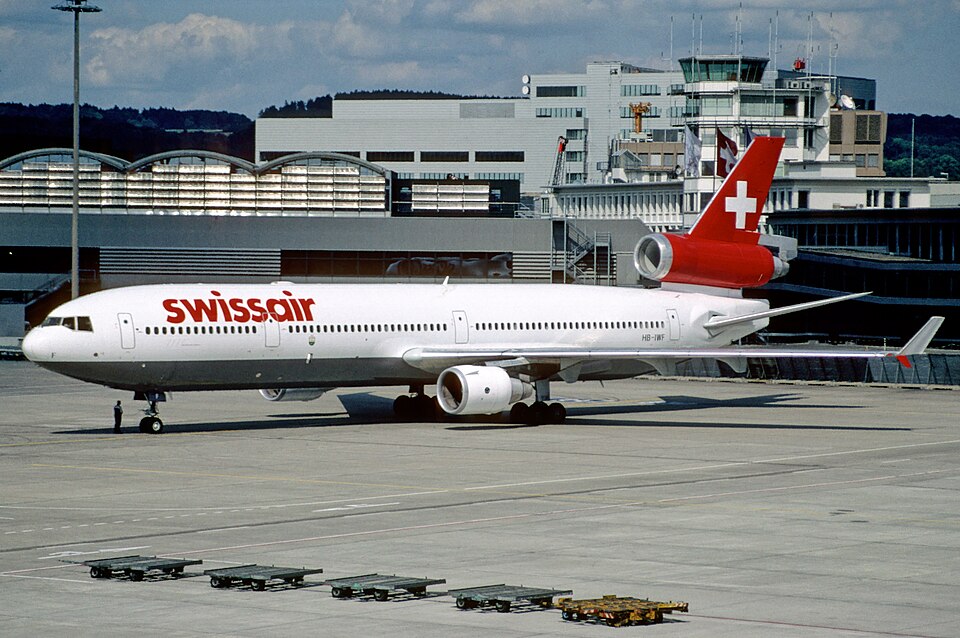
Background
Swissair Flight 111 was a scheduled international passenger flight from New York, United States, to Geneva, Switzerland. The aircraft, a McDonnell Douglas MD-11 registered HB-IWF, departed New York at 20:18 Eastern Daylight Time on September 2, 1998, with 215 passengers and 14 crew members aboard.
Flight Events
Approximately 53 minutes after departure, while cruising at Flight Level 330, the flight crew detected an abnormal odor in the cockpit. Their attention was drawn to an unspecified area behind and above them, and they began searching for the source. Initially, what they saw was no longer perceived as visible shortly afterward. They agreed that the odor originated from the air conditioning system. Upon determining that smoke was visible and had been for some time, they decided to divert and initially turned toward Boston. However, when air traffic control mentioned Halifax, Nova Scotia, as an alternate airport, they changed their destination to Halifax International Airport.
While the flight crew prepared for landing at Halifax, they were unaware that a fire was spreading above the ceiling in the forward part of the aircraft. About 13 minutes after detecting the unusual odor, the flight data recorder began recording a rapid succession of system failures. The flight crew declared an emergency and stated they needed to land immediately. Approximately one minute later, radio communications and secondary radar contact with the aircraft were lost, and the onboard recorders stopped functioning. About five and a half minutes after that, the aircraft struck the ocean approximately five nautical miles southwest of Peggy's Cove, Nova Scotia, Canada. The aircraft was destroyed, and there were no survivors.
Investigation
The Transportation Safety Board of Canada investigated the accident (report number A98H0003). The investigation focused on an in-flight fire that led to the loss of the aircraft. The report detailed the sequence of events and system failures but did not assign a probable cause in the provided excerpt.