Background
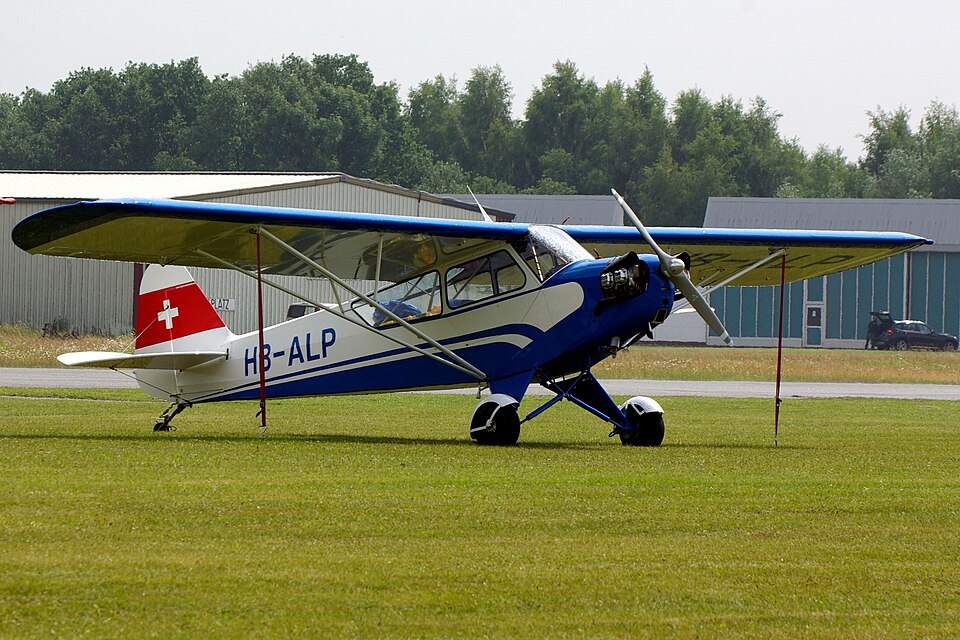
The aircraft involved was a Piper Cub (also known as Piper L-4), registered HB-ALP, owned by ALPAR A.G., Bern. It was powered by a 65-horsepower engine and had a maximum weight of 550 kg. Its airworthiness certificate was valid until 24 April 1964. The pilot was a student pilot, born in 1945, who held a learner license issued on 30 May 1963, valid until 14 February 1965. At the time, he was preparing for the intermediate examination required for cross-country flight authorization.
Flight Sequence
On the afternoon of 25 July 1963, the student pilot had already completed one solo training flight as part of a motor flight course. That flight departed at 1527 MEZ from grass runway 32 and was normal in every respect, although a thunderstorm was already visible in the Gürbetal south of the airfield. The instructor then ordered a repeat flight, and the student took off again at 1543 MEZ on the same runway.
As the student reached an altitude of 600 m (approximately 2,000 ft), he entered severe turbulence. The thunderstorm had moved toward the airfield, and strong, gusty thermic wind began blowing from the south. The instructor ordered the landing direction changed to runway 14 (the opposite direction) and had the landing signals rearranged accordingly. The student, preoccupied with controlling the aircraft in the turbulence, did not notice the change.
Accident
The student attempted to approach and land on runway 32 as usual. Due to a strong tailwind, he overshot the intended landing area and drifted northeast of the runway. Ground signals waving yellow flags were interpreted by the student as an instruction to land immediately. He managed to touch down on the airfield grass, but near the end of the hard runway and about 30 m to its right, in tall grass. During the landing roll with a tailwind, the aircraft entered a potato field and nosed over. The time of the accident was 1555 MEZ.
Damage and Injuries
No personal injuries occurred. The aircraft sustained damage: the propeller was bent, and the rudder was damaged. Estimated repair costs were approximately 2,000 Swiss francs, representing about 10% of the aircraft's value. Minor ground damage to the potato field was reported.
Probable Cause
The accident is due to the fact that the student pilot, during a solo flight, encountered severe thunderstorm turbulence and, under difficult conditions, could only partially control approach and landing.