Introduction
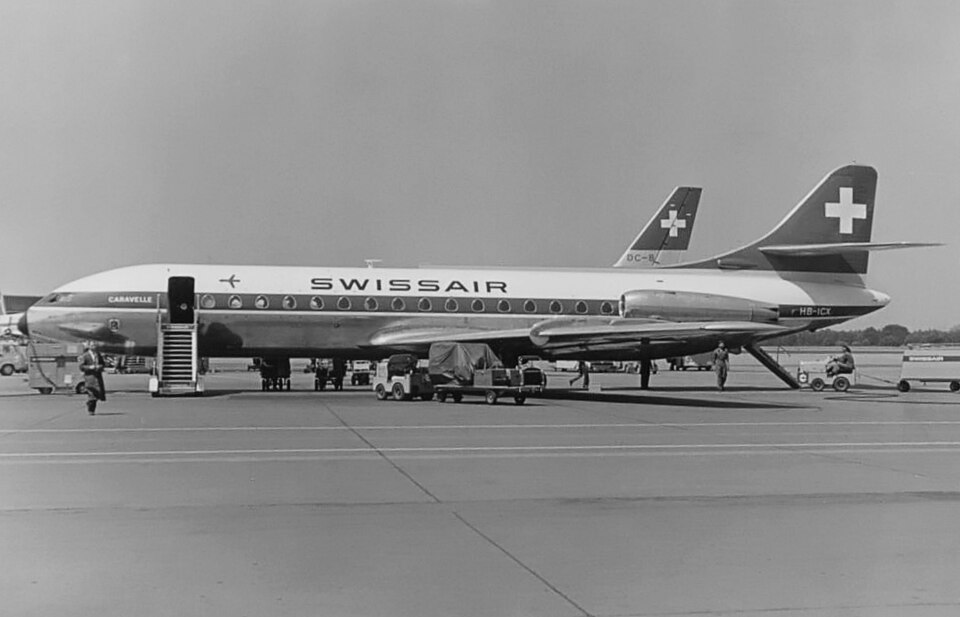
On 11 June 1965, an incident occurred at Geneva-Cointrin Airport involving a Sud-Aviation Caravelle SE-210, registration HB-ICX, operated by Swissair. The aircraft was preparing for departure to Frankfurt after a 50-minute stopover.
Incident Narrative
The Caravelle was parked approximately 50 meters in front of the large hangar, southwest of the control tower. Also parked in the area were three light aircraft. The marshaller was occupied with the arrival of a Carvair from British United Air Ferries (BUAF), so the supervisor handled the Caravelle's departure. As the Caravelle began to move, it needed to execute a sharp right turn of more than 90 degrees to exit its parking position, requiring higher engine power. During this maneuver, the jet exhaust momentarily directed towards the three light aircraft. The blast blew a Piper PA-18 Super-Cub, which pivoted and struck a person standing nearby. The incident occurred at 1209 hours local time.
Damage
The person struck was a British subject, born in 1913, employed as station manager for BUAF. He sustained injuries to his neck and right thigh, resulting in six days of incapacity for work. The Piper PA-18 Super-Cub suffered a dented aileron and some paint damage. Estimated repair costs were approximately 1,000 Swiss francs, with damage extent assessed at 5%.
Findings
The three light aircraft were properly chocked with chocks in front of and behind each wheel. The parking area in front of the large hangar was normally reserved for light aircraft, but due to construction on the main apron and increased traffic, it was also used for airliners. No painted markings indicated exact parking positions. The Caravelle's pilot applied 6,000 rpm, which was within the permissible range for the required sharp turn. The supervisor's involvement was in accordance with Swissair's Station Manual (STM 6.1.6).
Conclusion
The incident occurred because a parked light aircraft was blown by the jet blast of the Caravelle, causing it to pivot and strike a passerby.