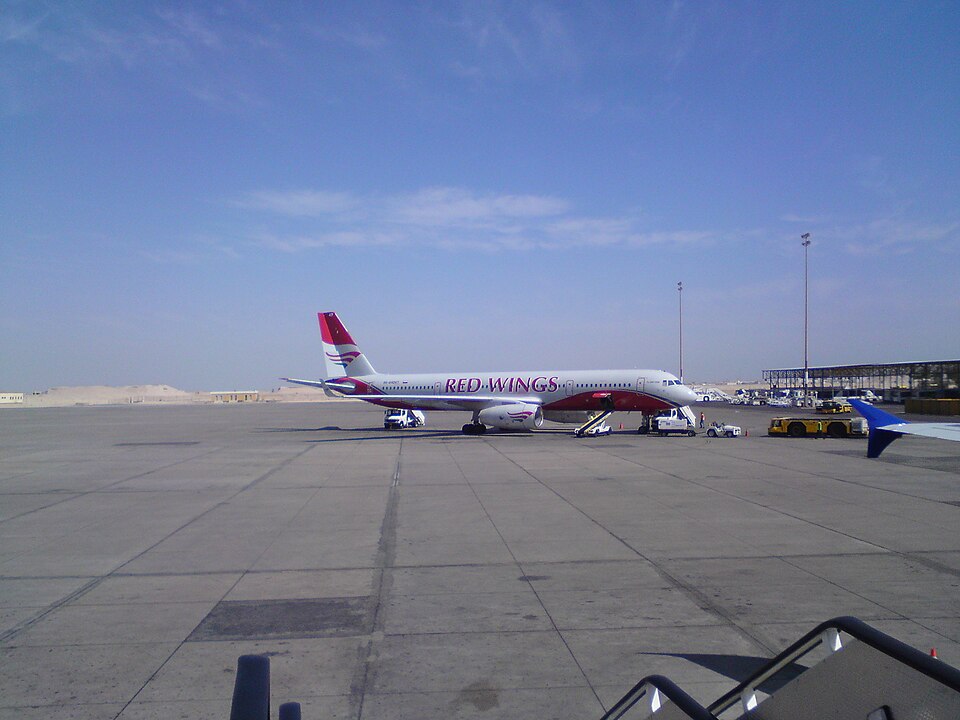
Accident Details
A Tu-204-100B (registration RA-64047) overran runway 19 at Moscow Vnukovo Airport during landing. The approach was conducted on runway 19, which has a length of 3,060 meters. The pilot-in-command was at the controls. Before entering the glide path, the aircraft was in landing configuration with flaps at 37°, slats at 23°, and landing gear down. The decision height was 60 meters. Landing weight was approximately 67.5 tons with an alignment of 26.5%, within flight manual limits.
Sequence of Events
The pilot-in-command determined the glide path reference speed as 210 km/h but specified that at least 230 km/h should be maintained. The glide slope descent was flown in director mode with automatic throttle disabled, averaging 255 km/h indicated airspeed and a vertical speed of -3 to -5 m/s. The descent was without significant deviations. The aircraft passed the outer marker at 65–70 meters altitude. The runway threshold was crossed at about 15 meters and 260 km/h. Five seconds after the throttle levers were moved to idle, the aircraft touched down at about 230 km/h, approximately 900–1,000 meters from the threshold, with a left bank of 1–1.5°. A right crosswind gust of up to 11.5 m/s was present. The vertical acceleration at touchdown was recorded as 1.12 g. About 10 seconds elapsed between passing 4 meters and touchdown.
Three seconds after landing, the nose gear strut compressed, but the right main gear strut compression signal had not yet formed. The crew moved the thrust reverser levers to maximum reverse in one motion and applied mechanical brakes. The reverse valves did not actuate. Air brakes and spoilers did not deploy automatically, and the crew did not manually extend them. After selecting maximum reverse, both engines produced forward thrust up to 90% Nvd. Hydraulic brake pressure reached 50 kgf/cm² on the left (compressed) landing gear but none on the right (uncompressed) gear. The aircraft slowed to 200–205 km/h at 7–8 seconds after landing, then speed increased. The flight engineer reported the reversers had not deployed. The thrust levers were held at maximum reverse for about 8 seconds, during which speed rose to 240 km/h. This increased speed further unloaded the main landing gear, causing alternating compression signals due to roll oscillations from 4.5° left to 2.6° right. When the reversers were turned off, the left-seat pilot applied brake pedal to 60%, but braking remained inefficient. Five seconds later, the flight engineer called for reverse again, and the levers were moved to maximum reverse again, but again no reverse deployment occurred, and engines produced forward thrust at 84% Nvd. Speed was 230–240 km/h. The reversers were turned off after 4 seconds. The aircraft was then about 900–1,000 meters from the far runway threshold. Six seconds later, the crew attempted to engage automatic braking, as evidenced by crew conversation and transient commands. When the aircraft passed the far threshold, the thrust levers were in small reverse. The overrun occurred 32 seconds after landing, with the aircraft nearly on the runway centerline at about 215 km/h. The flight engineer shut down the engines using emergency brakes. The aircraft continued rolling due to road bumps and snow cover. Both main gear struts compressed, activating air brakes and spoilers. The aircraft struck a ravine slope at about 190 km/h ground speed.
Casualties and Damage
Four stewardesses were seriously injured, and four other crew members were killed. One of the survivors died from injuries the following day. The aircraft was destroyed.
Probable Cause
The accident with Tu-204-100B RA-64047 was caused by actuator maladjustment and reverse locking of both engines and incorrect crew actions (not complying with FOM provisions) performing landing run during spoilers and thrust reverse control that resulted in lack of efficient aircraft braking action, runway overrun, collision with obstacles at a high speed (~190 km/h), aircraft destruction, and fatalities. Contributing factors included: actual structure stiffness of reverse control and locking mechanism unaccounted in operational documentation; incoordination and conflicts in aircraft and engine documentation and long-term formalism towards inspections; unstabilized approach and significant overspeed during glide slope; non-extension of spoilers and speed brakes in automatic mode due to lack of simultaneous left and right strut compression after a soft landing; lack of crew monitoring for automatic extension and manual non-extension of spoilers; violation of thrust reverse landing procedure; lack of simultaneous main landing gear compression due to limit switch design features; and inadequate cockpit resource management by the PIC.