Factual Information
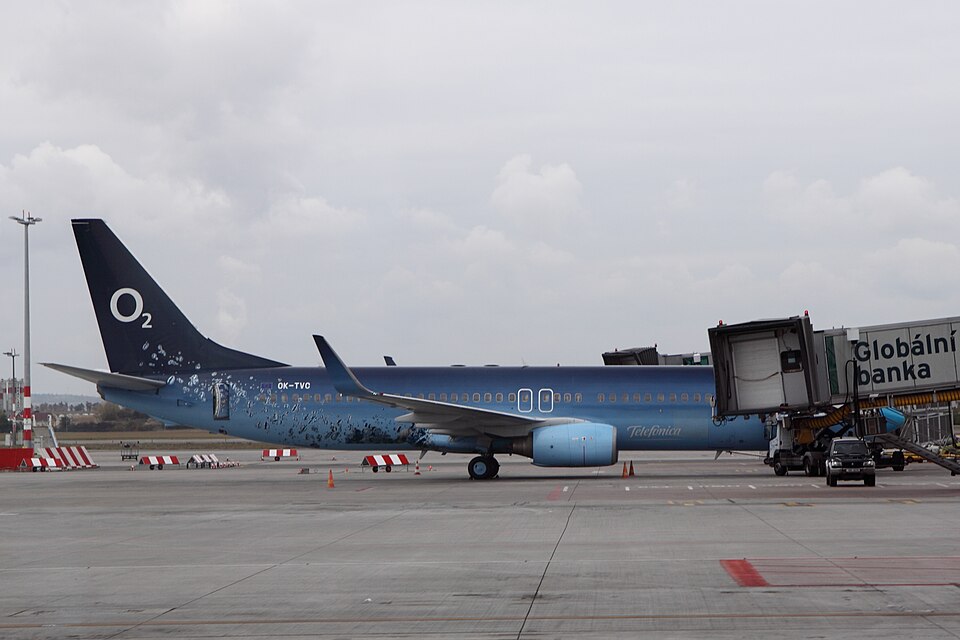
On 19 September 2006 at 04:50 UTC, a ground collision occurred during the towing of a Boeing 737-800, registration OK-TVC, at Prague Ruzyně Airport (LKPR). The aircraft was operated by Travel service a.s., and handling services were provided by Letiště Praha s.p. The tug involved was a Steward & Stevenson model GT-110. The tow bar was a P/N DPT 033NS52TH358C. Both the tug and tow bar were approved for towing the B737-800.
All personnel involved in the towing operation were properly qualified and held valid authorizations. The tug driver tested negative for alcohol; other crew members were not tested. The aircraft's auxiliary power unit (APU) was running, and the braking system was pressurized. The nose gear steering was deactivated by inserting the disconnect pin.
Sequence of Events
The aircraft had landed and was initially parked at stand 15. It was then towed to stand 56. Before the tug was disconnected, a decision was made to move the aircraft to final parking on closed runway 04/22. The tow route proceeded via taxiway H1, K, L, and P.
Shortly after turning from taxiway L onto taxiway P, the aircraft began to veer left spontaneously. The tug driver responded by steering right and sounding the horn to alert the mechanic in the cockpit. The aircraft started to oscillate left and right. During the oscillation, the tug avoided the aircraft, but the aircraft accelerated beyond the tug's speed and began to overtake it on the left side, while still connected by the tow bar.
The angle between the tug and aircraft exceeded the maximum steering angle, causing the tow bar to contact the rear of the tug and break at the forward bolted joint. The remaining part of the tow bar remained attached to the aircraft, forcing the nose wheel to turn right. The tug attempted to pull away but could not accelerate sufficiently. The right forward fuselage of the aircraft struck the left rear side of the tug. After impact, the nose wheel rode over the broken tow bar, turning the aircraft further right. The aircraft pushed the tow bar until it stopped approximately 100 meters from the turn, with the nose angled about 30° right of the taxiway centerline. The tug stopped about 40 meters away.
Damage
The aircraft sustained damage to the right forward fuselage, starting 10 cm aft of the pressure bulkhead and ending at structural element BS 220. The tear was up to 30 cm wide and approximately 150 cm long. No additional damage to the nose landing gear assembly from oversteering was found. The tug had minor damage to the left upper body. The tow bar was broken into two parts at the forward bolted joint.
Investigation Findings
Radar and security camera recordings were used to analyze the movement. The tug's speed indicator had a fault, but analysis determined it did not affect the event; the maximum speed in second gear was within permitted limits. The tow bar failure was examined: the shear pin of the tow bar mechanism fractured. Fracture surfaces showed fluctuating loading with local pressure increase at the upper shear section. A missing lower part of the pin was later found approximately 200 meters before the accident site on taxiway L. The analysis confirmed that the tow bar failure occurred during the collision sequence.
No injuries were reported. No other damage to airport equipment occurred.