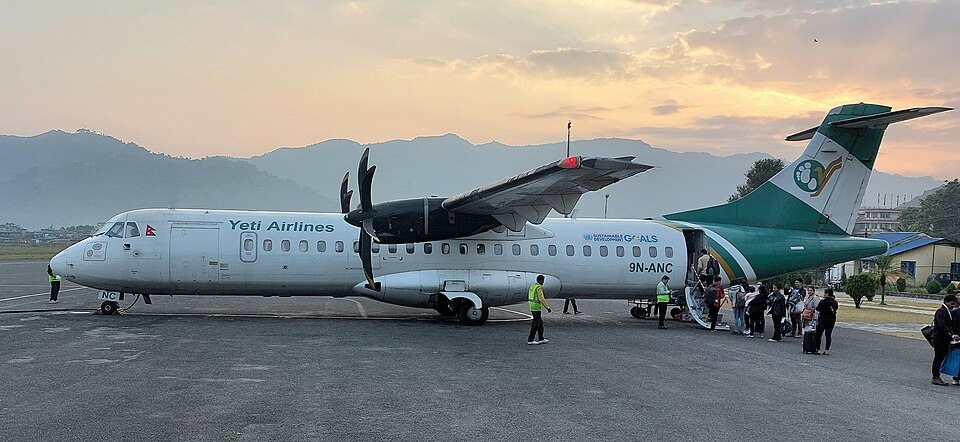
On 15 January 2023, an ATR72-212A version 500 aircraft, registration 9N-ANC, operating as Yeti Airlines flight NYT691 from Tribhuvan International Airport to Pokhara International Airport, crashed near Pokhara. The flight was the crew's third sector of the day, operating shuttle flights between Kathmandu and Pokhara. The aircraft carried 68 passengers and 4 crew members. During the final approach to runway 12 at Pokhara International Airport, the aircraft sustained a loss of control in flight and impacted terrain between the old Pokhara Domestic Airport and the new Pokhara International Airport. All 72 persons on board were fatally injured.
Investigation
The Government of Nepal constituted an Aircraft Accident Investigation Commission to determine the cause. The investigation involved participation from BEA France, TSIB Singapore, TSB Canada, and NTSB USA, in accordance with ICAO Annex 13. The commission issued a final report containing nine safety recommendations.
Probable Cause and Contributing Factors
The most probable cause was determined to be the inadvertent movement of both condition levers to the feathered position in flight. This resulted in the feathering of both propellers, leading to a loss of thrust, an aerodynamic stall, and collision with terrain.
Contributing factors identified by the investigation include:
- High workload due to operating into a new airport with surrounding terrain, and the crew missing associated flight deck and engine indications that both propellers had been feathered.
- Human factor issues such as high workload and stress, which appeared to have resulted in the misidentification and selection of the propellers to the feathered position.
- The proximity of terrain requiring a tight circuit to land on runway 12. This tight circuit was not the usual visual circuit pattern and contributed to high workload. It also meant the approach did not meet stabilized visual approach criteria.
- Use of a visual approach circuit for runway 12 without evaluation, validation, and resolution of its threats, which had been highlighted by the Safety Risk Management team of CAAN and advices proposed in the flight procedures design report, and without development and approval of the chart by the operator and regulator.
- Lack of appropriate technical and skill-based training (including simulator) for the crew and proper classroom briefings for the safe operation of the flight at the new airport for visual approach to runway 12.
- Non-compliance with standard operating procedures, ineffective crew resource management, and lack of sterile cockpit discipline.
Recommendations
The report issued nine safety recommendations to the Ministry of Culture, Tourism and Civil Aviation, the Civil Aviation Authority of Nepal, and Yeti Airlines to prevent similar occurrences.