History of the Flight
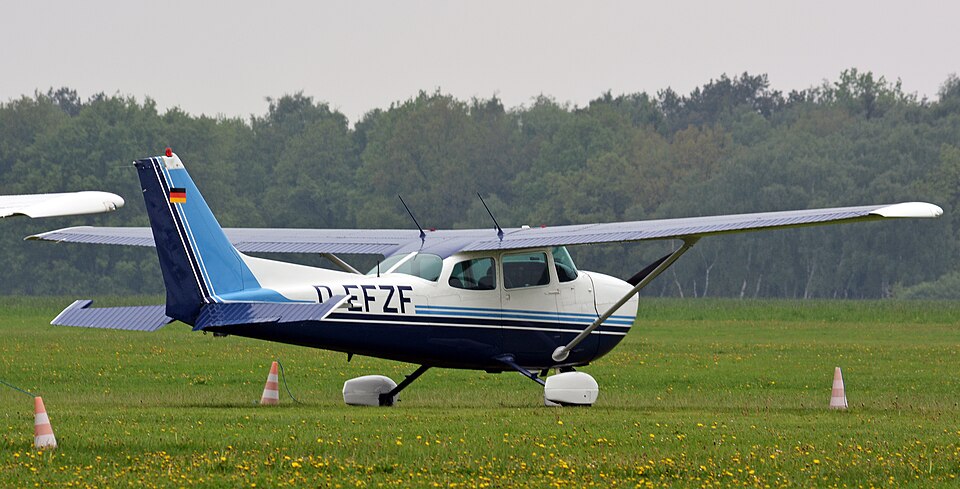
The Cessna 172, registered D-EFZF, was one of three aircraft on a multi-day cross-country flight from Germany to France. The pilot, in the left seat, and the passenger, who owned the aircraft, had taken off from Dijon-Longvic aerodrome around midday, bound for Tours Val de Loire.
On final approach to runway 20, the pilot configured the aircraft with flaps at 30° and maintained a speed of approximately 70 kt with engine idle. During the flare, a slight power increase occurred for a few seconds. The pilot then executed a go-around. The aircraft veered left with minimal altitude gain, stalled at low height, and collided with terrain near a radome within the airfield grounds.
Pilot and Passenger Information
The 59-year-old German pilot held a private pilot licence issued in September 1987. He had logged 367 flight hours, including 107 hours on the Cessna 172 type. In the three months preceding the accident, he had flown four hours, all on type. The pilot reported no technical issues with the aircraft. He stated that during the go-around, he observed a nose-up attitude variation and pushed the wheel to maintain level flight. He felt increasing pressure and noticed a left veer. Believing the passenger (the owner) had taken control, he stopped making inputs. The passenger, also a 59-year-old private pilot with 1,228 hours (1,132 on type), stated he could not reach the controls fully as his seat was pushed back for comfort. He said he only attempted to push the wheel at the very end, just before the stall. Both occupants evacuated unharmed and observed that the flaps were retracted.
Aircraft Information
The damaged Cessna 172 (model N modified to P via Supplemental Type Certificate) was equipped with a 160 hp Lycoming O-320-D2J engine and a flap limitation of 30°. The propeller turned clockwise as viewed from the cockpit. A camera attached to the right wing tip recorded the event.
Analysis of Camera Recording
BEA analysis of the video and audio from the camera provided a timeline. The aircraft was established on final about 700 m from the runway 20 threshold at a height of 100 m, with an approach slope of approximately 5° (four white PAPI lights). The threshold was crossed at 25 m height (red PAPI lights). The flare began at T0+30 s. At T0+37 s, a slight engine speed increase occurred for five seconds. Power was applied and the go-around started at T0+44 s. The path bent left at T0+49 s, with increasing left bank and little height gain. At T0+58 s, a high left bank at low height was seen. Impact occurred at T0+1 min 02 s. A noise similar to flap retraction was heard for about six seconds starting at T0+1 min 06 s.