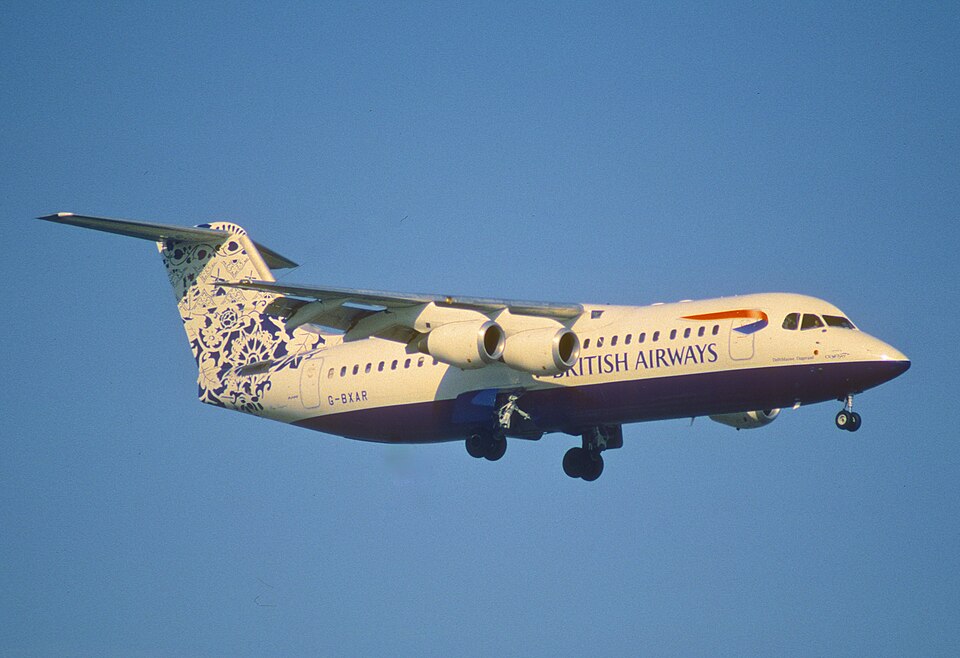
On February 13, 2009, an Avro RJ100 (registration G-BXAR) operated by British Airways (1973) was involved in an aviation accident near London-City, United Kingdom during landing or approach. No fatalities were reported. Investigators recorded the probable cause as: The nose landing gear main fitting failed following the formation of multiple fatigue cracks within the upper section of the inner bore, originating at the base of machining grooves in the bore surface. This summary draws on records from the Bureau of Aircraft Accidents Archives (B3A); 3 related events involving the same aircraft type or operator are linked below.
During landing, the nose landing gear main fitting fractured, causing the gear to collapse rearward and penetrate the fuselage. Smoke from hydraulic fluid entered the cockpit and cabin. Battery disconnection led to loss of PA and cockpit door release. No pre-accident defects in manual door release or PA.
Incident
Following a normal touchdown, the fracture of the nose landing gear main fitting allowed the nose gear to collapse rearwards and penetrate the lower fuselage. This caused significant damage to the equipment bay and the battery to become disconnected. The penetration of the fuselage allowed smoke and fumes produced by the consequent release of hydraulic fluid to enter the cockpit and passenger cabin. With the battery disconnected and after the engines were shut down, all power to the aircraft PA systems was lost and the remote cockpit door release mechanism became inoperative. No pre-accident defects were identified with the manual cockpit door release mechanism or the PA system.
Investigation Findings
The investigation determined that the nose landing gear main fitting failed following the formation of multiple fatigue cracks within the upper section of the inner bore, originating at the base of machining grooves in the bore surface. These cracks had formed because the improved surface finish, introduced by Service Bulletin 146-32-150, had not been properly embodied at a previous overhaul by Messier Services Inc, despite their overhaul records showing its incorporation. The operator had been in full compliance with the Service Bulletin relating to regular inspection of the main fitting, and embodiment of SB 146-32-150 at overhaul removed the requirement for these inspections by the operator.
Probable cause
The nose landing gear main fitting failed following the formation of multiple fatigue cracks within the upper section of the inner bore, originating at the base of machining grooves in the bore surface. These had formed because the improved surface finish, introduced by SB 146-32-150, had not been properly embodied at previous overhaul by Messier Services Inc, despite their overhaul records showing its incorporation. The operator had been in full compliance with the Service Bulletin relating to regular inspection of the main fitting, and embodiment of SB 146-32-150 at overhaul removed the requirement for these inspections by the operator.
An X-AIR HAWK ultralight crashed in Chonburi, Thailand, killing the pilot and injuring a passenger. The accident was caused by deteriorated wing fabric and…
A Challenger II Special ultralight aircraft (U-B23) landed off-runway at Pai Airport, Mae Hong Son, on September 17, 2024, due to a gust of wind. No injuries…
The Polish aviation safety authority is investigating a serious incident involving an AT-3R100 aircraft that occurred on September 2, 2024. The investigation…
A SZD-48-3 glider suffered damage when its left wing struck a ground obstacle during a low final approach at EPWK on June 20, 2025. The pilot was uninjured.
A 39-year-old skydiver died after a hard landing near Leszno on May 1, 2026. The PKBWL preliminary report indicates the fatal impact resulted from a late,…
A student pilot crashed an SZD-50-3 Puchacz glider into the airfield fence during a solo training flight on June 6, 2026. The pilot was uninjured, but the…