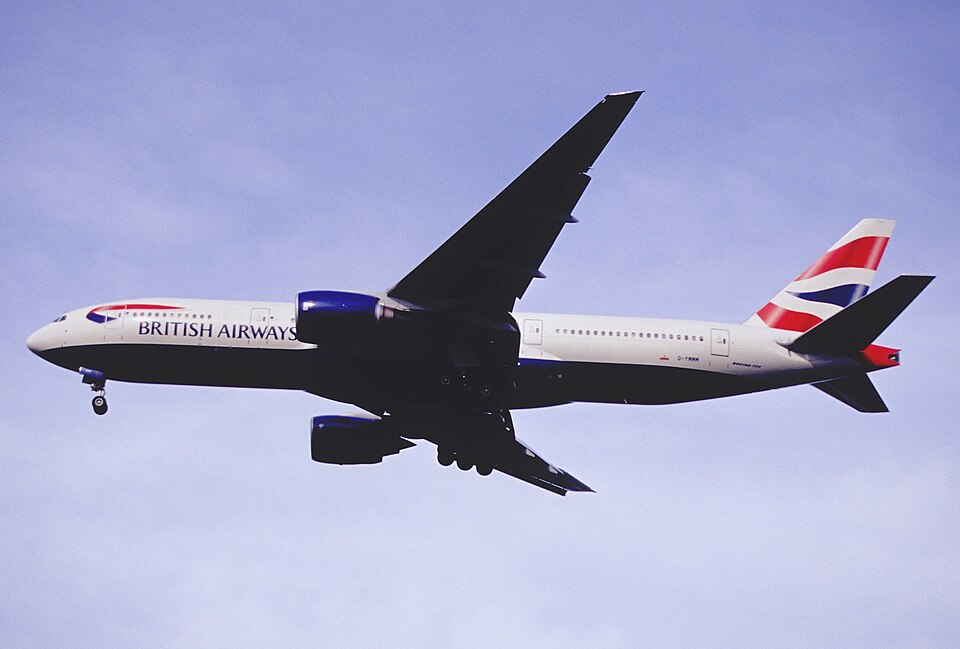
Accident Overview
On 17 January 2008 at 1242 UTC, a Boeing 777-236ER, registration G-YMMM, experienced a loss of engine thrust during final approach to Runway 27L at London Heathrow Airport. The aircraft was operating a commercial passenger flight from Beijing, China. On board were 16 crew and 136 passengers. Injuries included four crew with minor injuries, one passenger with serious injuries, and eight passengers with minor injuries. The aircraft sustained damage beyond economic repair. The commander, aged 43, held an Airline Transport Pilot's Licence and had accumulated 12,700 flying hours, including 8,500 hours on type.
Investigation Progress
The Air Accidents Investigation Branch (AAIB) initiated the investigation immediately upon notification at 1251 hrs on the day of the accident. The National Transportation Safety Board (NTSB) of the USA, representing the state of design and manufacture, appointed an Accredited Representative supported by investigators from the NTSB, Federal Aviation Administration (FAA), Boeing, and Rolls-Royce. British Airways, the operator, cooperated with the investigation. The Civil Aviation Authority (CAA) and European Aviation Safety Agency (EASA) were kept informed.
Flight and Engine Event
The flight from Beijing to London was uneventful with normal engine operation until the final approach. During approach, the autothrottles commanded increased thrust from both engines, and the engines initially responded. At approximately 720 ft agl, the thrust of the right engine reduced to about 1.03 EPR; seven seconds later, the left engine thrust reduced to about 1.02 EPR. This thrust reduction, or rollback, resulted from reduced fuel flow, and all engine parameters were consistent with reduced fuel flow.
Related Event
On 26 November 2008, a Boeing 777-200ER (N862DA) operated by an American carrier and powered by Rolls-Royce Trent 895 engines experienced an uncommanded rollback of the right engine during cruise at FL390 near Great Falls, Montana. The crew executed procedures introduced after the G-YMMM accident, recovered normal engine control, and landed without further incident. Although flight phase and conditions differed, many rollback characteristics were similar, including fuel temperature. Analysis of data from both events and testing by manufacturers enabled the investigation to understand how ice generated within the fuel system might lead to engine rollback.
Fuel Oil Heat Exchanger Restriction Tests
The initial AAIB report noted that testing showed ice could restrict fuel flow at the Fuel Oil Heat Exchanger (FOHE) inlet under certain conditions. However, during all tests, fuel flow never fell below that required for flight idle, and the restriction could be cleared by reducing fuel flow to idle, which melted the ice. Further testing established that 25 ml of water, introduced at high concentration, could form sufficient ice to restrict FOHE flow. No restriction occurred when main tank fuel temperature was above -15°C (5°F) at 6,000 pph or above -10°C (14°F) at 12,000 pph. The FOHE was certified to all applicable requirements at the time; the tests conducted were, to AAIB knowledge, unprecedented.
Further Testing on Fuel Rig
To determine how ice might accumulate in the fuel feed system, the aircraft manufacturer reconfigured a fuel rig to include the majority of G-YMMM's right fuel system feed pipes, arranged to replicate cruise attitude. An environmental tank with cold fuel simulated the main tank environment. An insulated box with dry ice controlled temperatures around pipes passing through centre cheek tanks. Pipes along the engine pylon were exposed to ambient conditions, which thermal modelling indicated approximated cruise temperatures.
Tests were conducted with fuel flowing for 3, 6, and 7 hours at 6,000 pph, with water concentration of approximately 90 ppm and fuel temperatures of 5°C, -12°C, -20°C, and -34°C. Observations included:
- Ice formed around the inside of fuel feed pipes when warm fuel (5°C) from the centre tank passed through colder main tank fuel (-20°C).
- Ice formed around all feed pipes from boost pump discharge to front of strut after 3 hours at -12°C and -20°C, with thickness of 1 to 2 mm; more consistent ice at -12°C.
- Very little ice formed at -34°C.
- Longer duration tests (6 hours) showed less repeatability in ice amounts.
- When fuel temperature was cooled from -12°C to -33°C over 7 hours, ice amount was consistent with the 3-hour run at -12°C.
- Ice was soft and easily moved; surface appeared 'pebbly' during the cooling test.
- In some tests, ice accumulation on pipe walls was noted; however, the test rig pipes did not replicate the exact aircraft geometry, material, or environment.
Boost Pump Inlet Screen Blockage
During testing, blockage of the fuel boost pump inlet screen occurred on six occasions, believed to be an artefact of the water introduction method. These restrictions were characterized by a drop in fuel pressure, boost pump low pressure warning, and reduced electrical current draw. Data from the accident flight indicated that the boost pump low pressure switches did not trigger, making inlet screen icing unlikely as the cause of the fuel flow restrictions on G-YMMM.
Observations on Other Components
Tests showed no restrictions in other fuel system components or fuel feed pipes, aside from inlet screens and the FOHE. In some long-duration tests, ice accumulated on the inside of pipe walls at low fuel flow, suspected to clear when flow increased. However, the test rig pipes did not match aircraft installation geometry, material, or environmental exposure.