63 fatalities

1976 Zagreb Mid-Air Collision (G-AWZT)

Vrbovec, CroatiaFlight

On September 10, 1976, a Hawker Siddeley HS.121 Trident (registration G-AWZT) operated by British Airways (1973) was involved in an aviation accident near Vrbovec, Croatia in flight. 63 people were killed. Investigators recorded the probable cause as: The direct cause was the impact of the DC-9 wing into the middle side of the Trident 3B fuselage at 33,000 feet above the Zagreb VOR, rendering both aircraft uncontrollable. This summary draws on records from the Bureau of Aircraft Accidents Archives (B3A); 3 related events involving the same aircraft type or operator are linked below.
Sourcesthe Bureau of Aircraft Accidents Archives (B3A)Primary reportUpdated 2026-06-12Data APIEditorial standards
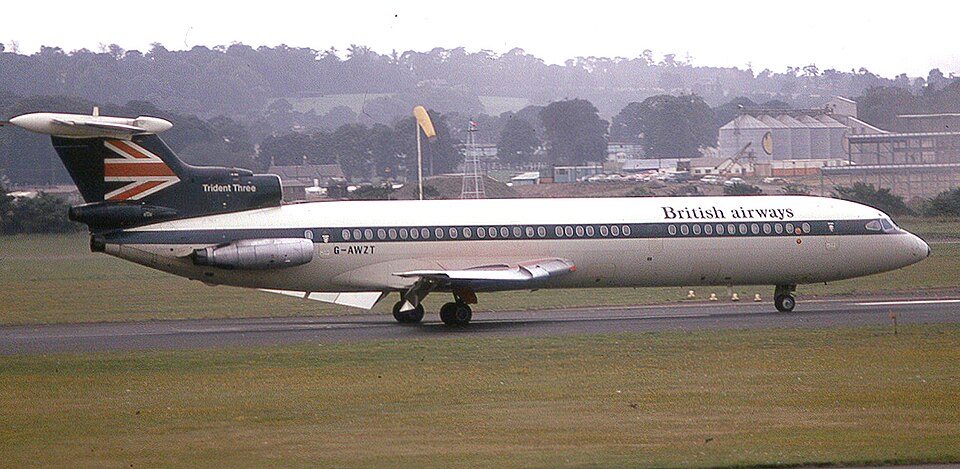
Aircraft registered G-AWZT
Aircraft registered G-AWZT. Photo: Mike McBey / CC BY 2.0, via Wikimedia Commons

A British Airways Trident and an Inex-Adria DC-9 collided near Vrobec, killing all 176 people on board. The crash was attributed to ATC errors and failure to maintain look-out.

Incident Overview and Aircraft Details<br>On a scheduled international flight, a Hawker Siddeley HS-121 Trident 3B operated by British Airways as flight BE476 met a McDonnell Douglas DC-9-32 operated by Inex-Adria Aviopromet in a mid-air collision near Vrobec. Both aircraft were destroyed, and all 176 individuals aboard the two planes perished. The British Airways aircraft was traveling from London-Heathrow Airport in England to Istanbul-Yesilköy Airport in Turkey, carrying 54 passengers and a crew of nine. The Inex-Adria DC-9 had departed from Split Airport at 09:48 GMT, transporting 108 West German tourists to Cologne.<br><br>## Flight Progression and Air Traffic Control Communications<br>The Trident took off at 08:32 GMT and proceeded normally until it established contact with the Zagreb Area Control Centre on the Upper Sector frequency of 134.45 MHz at 10:04 GMT. It was instructed to report passing the Zagreb VOR at flight level 330. The aircraft maintained a course along the centerline of airway UB5, deviating slightly to the right due to wind. Two minutes and fifty seconds before the collision, the crew adjusted their heading to 115 degrees to return to the airway centerline at an airspeed of 295 knots.<br><br>The DC-9, designated as flight JP550, received initial clearance to climb to flight level 180. At 09:54 GMT, while passing flight level 130, the crew switched to the Zagreb Area Control Centre lower sector east frequency of 124.6 MHz, receiving subsequent clearances to climb to flight levels 240 and 260. At 10:03 GMT, the crew switched to the middle sector controller's frequency, who cleared the flight to flight level 350. The aircraft maintained a heading of 353 degrees and a speed of 273 knots as it passed a beam west of the KOS NDB, approximately 2 to 3 kilometers from the airway centerline.<br><br>## Collision Sequence and Physical Damage<br>At 10:14:04 GMT, the DC-9 crew radioed the Upper Sector controller on 134.45 MHz, reporting they were climbing through flight level 325. The controller, speaking in Serbo-Croatian, instructed the flight to maintain their present altitude and report passing the Zagreb VOR, stating that an aircraft was passing from left to right at flight level 335. In reality, the British Airways Trident was at flight level 330. At 10:14:38 GMT, the DC-9 crew replied in Serbo-Croatian that they were maintaining flight level 330. Three seconds later, the two aircraft collided.<br><br>The outer five meters of the DC-9's left wing penetrated the side of the Trident's fuselage near the cockpit. The sudden decompression caused the forward section of the Trident to disintegrate, with the remaining fuselage striking the ground tail-first. The DC-9, with its left wing torn off, tumbled downward and impacted the ground right-wing first.<br><br>## Official Findings<br>The official investigation identified the direct cause as the impact of the DC-9 wing into the middle side of the Trident fuselage at an altitude of 33,000 feet above the Zagreb VOR, rendering both aircraft uncontrollable. Contributing factors included improper air traffic control operation, non-compliance with regulations regarding continuous listening to appropriate ATC radio frequencies, and the failure of both flight crews to perform look-out duties.

Probable cause

The direct cause was the impact of the DC-9 wing into the middle side of the Trident 3B fuselage at 33,000 feet above the Zagreb VOR, rendering both aircraft uncontrollable. Contributing factors included improper ATC operation, non-compliance with continuous listening regulations, and failure to perform look-out duties.