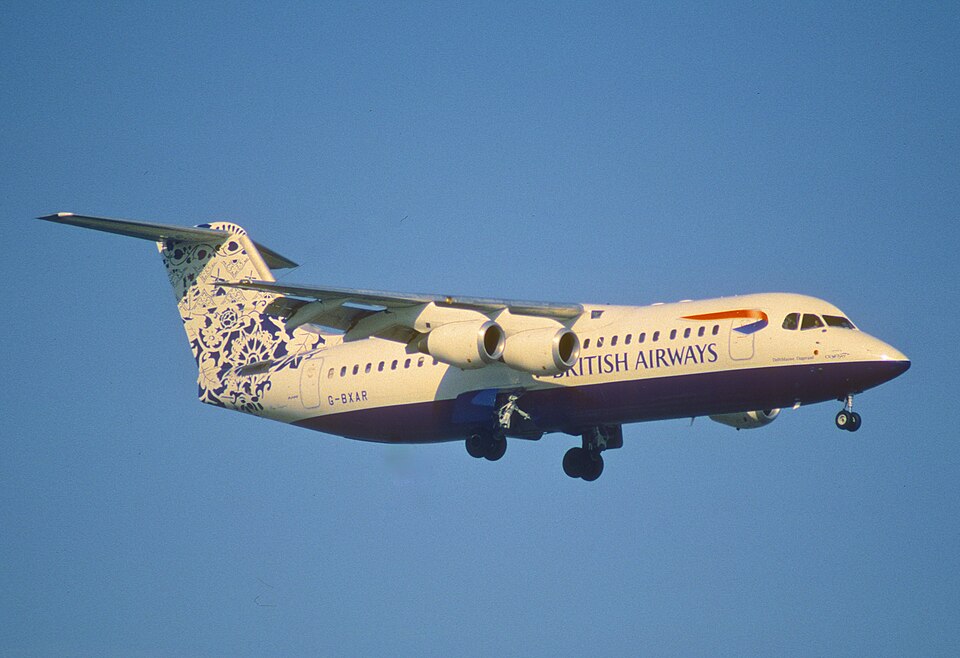
Accident Summary
On 13 February 2009 at 1940 UTC, an Avro 146-RJ100, registration G-BXAR, experienced a nose landing gear collapse during landing at London City Airport. The aircraft was operating a scheduled passenger flight from Amsterdam. There were 5 crew and 67 passengers on board. Two passengers sustained minor injuries, and two others were hospitalized overnight. The aircraft sustained damage to the nose landing gear, lower forward fuselage, and internal equipment.
History of the Flight
The instrument landing system approach to Runway 27 was uneventful. After the main wheels touched down, the commander, who was pilot flying, lowered the nosewheel onto the runway. The aircraft continued to pitch down until the fuselage contacted the surface. The commander applied full wheel brakes as smoke began to emanate from behind the instrument panel, followed by the illumination of the ELEC SMOKE warning. The co-pilot transmitted to air traffic control that they were stopping on the runway, and the commander issued a MAYDAY call with the intention to evacuate once stopped.
Evacuation and Smoke
After the aircraft came to a stop, the commander shut down the four engines and ordered an evacuation via the public address system. The crew donned oxygen masks. The co-pilot operated the engine fire handles by feel due to dense smoke. The commander attempted to open the locked cockpit door, first electrically then manually, but the restrictive oxygen hose limited movement. She removed her mask to lean out the direct vision window and confirmed with the purser that all passengers had evacuated. The crew then vacated via the cockpit windows. The three cabin crew members executed the evacuation. Most passengers exited via the rear slides; only one used the front left exit. The public address system had ceased working after engine shutdown due to loss of electrical power and battery disconnection from fuselage damage. Passengers reported queuing in the aisle, though cabin crew stated this was not an issue.
Examination of the Landing Gear
The nose landing gear fractured at a point above its pivot, near the top of the leg. The retraction actuator and torque links also broke. The fracture surface showed areas of fatigue crack progression and a large overload area. The upper portion of the main fitting was relatively undamaged. The gear had accumulated 18,299 flight cycles since new and had last been overhauled in January 2006, incorporating Service Bulletins SB 146-32-149 and SB 146-32-150, as per maintenance records. However, metallurgical examination revealed that the surface roughness near the crack origin was 9.5 to 10 microns, exceeding the production limit of 3.2 microns and the SB 146-32-150 requirement of 1.6 microns. The shot-peening process had been applied, but the surface finish was poor.
Cause
The probable cause was a fatigue crack in the upper internal bore of the nose landing gear main fitting. The crack formed due to poor surface finish during manufacture and incomplete embodiment of Messier Dowty Service Bulletin SB 146-32-150, which did not achieve the specified surface roughness.