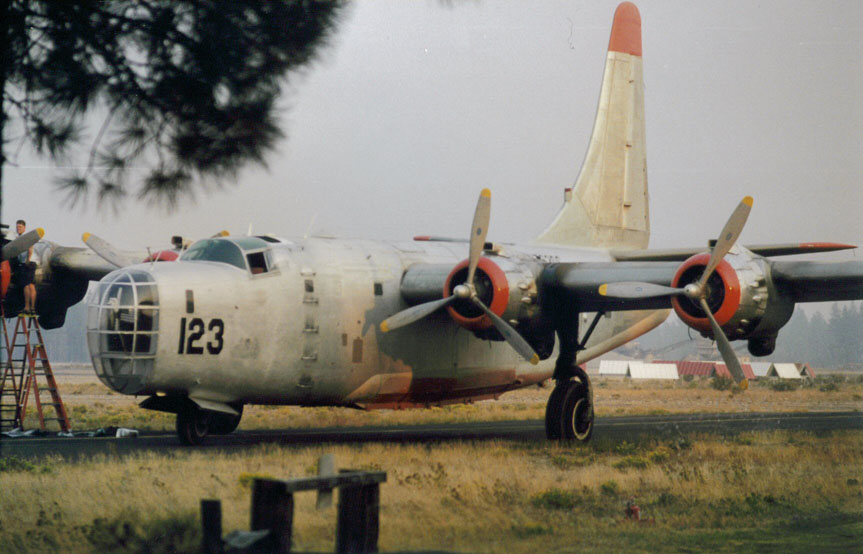
Structural failure leads to air tanker crash in mountainous terrain

2 fatalities • Estes Park, United States of America • Flight

An air tanker lost its left wing during a fire retardant drop maneuver, resulting in a fatal crash into mountains.

What happened

During a mission to distribute fire retardant, the aircraft type experienced a catastrophic structural failure. While performing maneuvers, the left wing detached from the wing root. This separation caused the crew to lose all control of the aircraft, which subsequently entered a 45-degree dive with a counterclockwise roll before impacting mountainous terrain. Ground observers captured photographic evidence of the wing separating from the fuselage during the descent.

The aircraft, which had been converted for civilian firefighting use in 1958 after serving in the military from 1945 to 1956, was operating in a capacity for which it was not originally designed. There were 0 fatalities reported among the crew, though the impact was total.

Findings

Post-accident inspections of the wreckage identified significant preexisting fatigue within the lower spar cap of the left wing's forward spar, as well as damage to the adjacent spar web and lower wing skin. The specific area where the fatigue cracks developed was hidden from view by the aircraft's internal retardant tanks, making it impossible to identify the damage through standard external visual inspections.

Further investigation of two similar air tankers revealed that the structural area prone to such failure was obscured by the fuselage construction. While the operator had established maintenance and inspection protocols, these procedures were insufficient for detecting critical fatigue. The inspection guidelines were derived from outdated 1948 U.S. Navy structural repair manuals, which failed to provide adequate instructions for locating cracks in these specific, obscured locations.

Probable cause

Inadequate inspection procedures failed to identify structural fatigue hidden by the aircraft's internal components and fuselage construction.

Frequently asked questions

What happened in the 2002-07-18 Consolidated PB4Y-2 Privateer accident near Estes Park, United States of America?

An air tanker lost its left wing during a fire retardant drop maneuver, resulting in a fatal crash into mountains.

Were there any fatalities in the 2002-07-18 Consolidated PB4Y-2 Privateer accident?

The accident was fatal, resulting in 2 fatalities.

What aircraft was involved and where did it happen?

The accident on 2002-07-18 involved a Consolidated PB4Y-2 Privateer, registration N7620C, operated by Hawkins & Powers Aviation, at Estes Park, United States of America.

What was the probable cause of the accident?

Inadequate inspection procedures failed to identify structural fatigue hidden by the aircraft's internal components and fuselage construction.

Loading the flight search…

What you can do on Flight Finder

  • Search flights between any two airports with live fares.
  • By aircraft — pick a plane model (e.g. Boeing 787, Airbus A350) and see every route it flies from your origin.
  • Route map — click any airport worldwide to explore its destinations, or draw a radius to find nearby airports.
  • Global aviation safety — aviation accident database, 40,000+ records since 1980, with map and rankings by aircraft and operator.
  • NTSB safety feed — recent U.S. aviation accidents and incidents from the official NTSB CAROL database, updated daily.