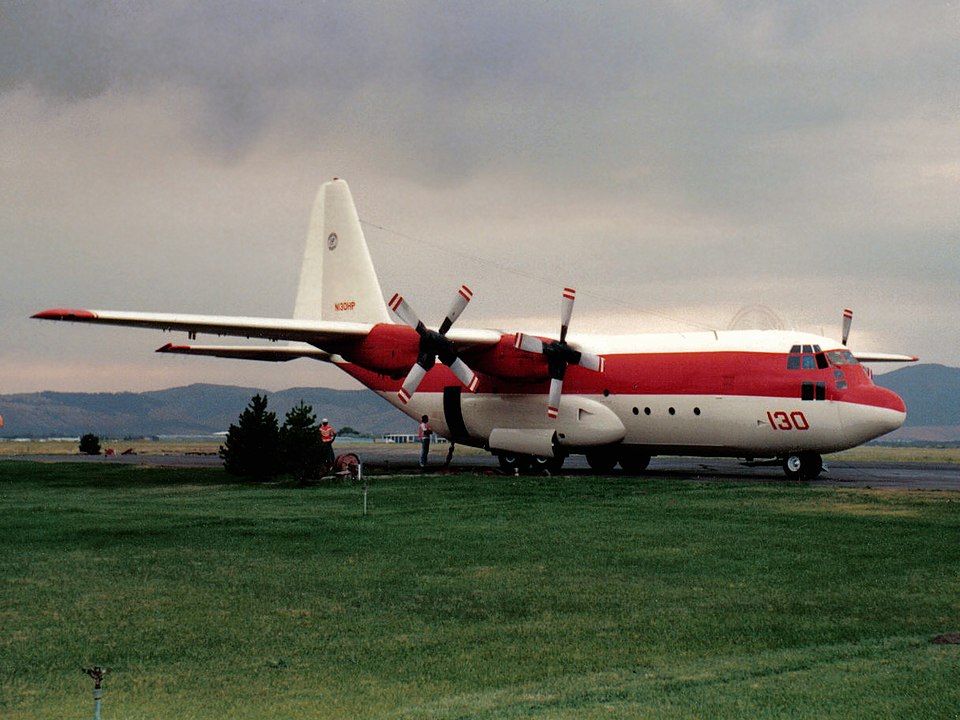
Accident Sequence
The aircraft was conducting a fire retardant drop over a mountain drainage valley. Video footage captured the sequence: as the drop neared completion, the nose began rising and the descent arrested. The nose continued to rise, and the wings folded upward until they detached from the fuselage at the center wing box beam-to-fuselage attachment. The video showed the right wing folding upward first, followed by the left wing about one second later.
Metallurgical Examination
Metallurgical analysis of the center wing box lower skin revealed a 12-inch fatigue crack on the lower surface of the right wing beneath the forward doubler. The crack had two separate initiation sites at stringer attachment rivet holes, which join the external doubler and internal stringers to the lower skin panel. These cracks eventually linked into a single crack. The fatigue crack was covered by a manufacturer-installed doubler, which would have hidden it from external visual inspection.
Aircraft History
The aircraft was delivered new to the U.S. Air Force (USAF) in 1957 and retired from military service in 1978. It was stored in a desert facility until 1988, when the U.S. Forest Service (USFS) acquired it for fire suppression use. It was then transferred to a civilian contractor, modified for firefighting, and later sold to a Part 135 operator. The FAA certificated it in the restricted category under a type certificate held by the USFS.
A Lockheed study found that firefighting missions impose stresses substantially more severe than typical military logistics operations. Aircraft in this role would require inspection intervals up to 12 times more frequent than typical military transport usage to meet damage tolerance requirements. Lockheed reported that nondestructive x-ray inspection methods then current in industry and military depot maintenance could have detected the fatigue cracks with high confidence when they were 0.50 to 0.75 inches long.
Maintenance and Regulatory Background
The operating limitations accompanying the restricted certificate required the aircraft to be flown and maintained in accordance with the then-current (1988) USAF technical orders for the C-130A. However, the USAF depot level maintenance program was not included in these technical orders and was not specified on the certificate's limitations. The limitations letter did not require compliance with USAF maintenance program modifications issued after 1988.
The operator devised a maintenance and inspection program based on the specified USAF technical orders but did not develop a depot level inspection requirement to ensure long-term airworthiness and damage tolerance, accounting for the stresses of the firefighting role and the aircraft's age.
The investigation found five separate FAA type certificates for C-130A tankers, held by five firms. None were standardized, none specified a depot level maintenance program, and none required full compliance with all military airworthiness technical orders.
In 1991, the Department of Interior (DOI) began to doubt the continued airworthiness of the C-130A tanker fleet and was concerned that the lack of depot maintenance or full compliance with military technical orders could compromise safety. The DOI asked the FAA to standardize the type certificate and mandate maintenance improvements. The USAF agreed and urged the FAA to require operators to establish a depot level continuing airworthiness program and comply with all technical orders.
In 1993, FAA management internally agreed that the DOI and USAF positions had merit and began developing requirements. Later that year, in a meeting with the FAA, DOI, USFS, and operators, the USFS and operators objected to depot maintenance and full compliance due to potential economic impacts. As of the time of the accident, the FAA had not standardized the type certificates nor imposed additional maintenance or inspection requirements.