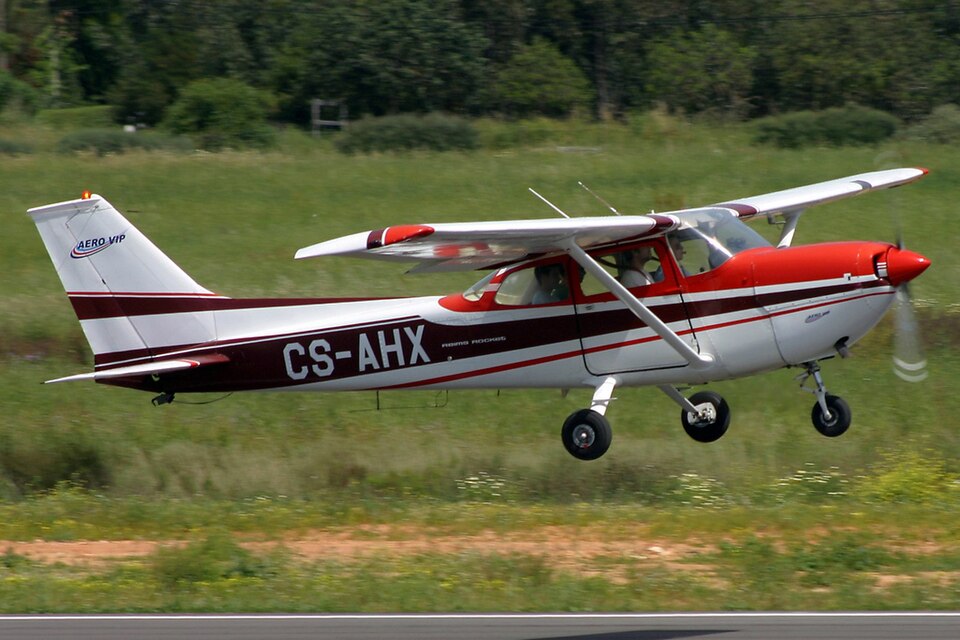
Flight History
On 13 July 2008 at 16:10 UTC, a Cessna 172, registration CS-AHX, operated by AERO VIP, Lda, was conducting an aerial work flight towing a banner along the Algarve coast. While passing near Vilamoura, Loulé, the pilot perceived a loss of engine power. The pilot checked all engine instruments in the cockpit and found all parameters normal. Despite this, the engine did not develop sufficient power to maintain the flight path, forcing a descent to preserve airspeed. The pilot released the banner and sought a suitable location for an emergency landing. The aircraft touched down in an empty agricultural field adjacent to the Vilamoura wastewater treatment plant. The landing was normal, and the aircraft sustained no damage. The pilot exited uninjured.
Aircraft and Crew
The aircraft was a single-engine, high-wing, fixed tricycle-gear Cessna 172 (model FR-172 H) manufactured by Reims Aviation in 1972, serial number 0332. It had a four-seat capacity and a maximum takeoff mass of 1157 kg. The engine was a Teledyne Continental IO-360-D, and the propeller was a McCauley D2A34C67-N. The airframe had accumulated 3719:39 hours; the engine, 2071:20 hours since new. The last inspection on all components was on 16 June 2008. The aircraft was certified for banner towing and its airworthiness certificate was valid until 28 June 2009.
The sole pilot held a Commercial Pilot License (CPL(A)) with multi-engine, single-engine, and flight instructor ratings, valid until 12 February 2013. The medical examination was valid from 24 January 2008 with no limitations. Total flight experience was 579 hours 30 minutes.
Examination and Findings
Inspection of the engine revealed a fracture in the metal fuel supply tube to cylinder #3. The fracture occurred at the weld joint where the tube attaches to the retainer fitting near the fuel injector. At the opposite end, the tube remained connected to the fuel control unit, allowing fuel to spill externally and reducing pressure in the supply line. Consequently, cylinder #3 became inoperative, and the remaining cylinders received lower fuel pressure, preventing the engine from producing required power.
Further examination found that soft clamps for attachment points were installed on the fuel tubes, but the tubes were not secured along their runs—they were only fixed at the ends. Engine vibrations could propagate along the tubes and, over time, weaken the material, particularly at the weld zone, which appeared most fragile. The fuel spillage occurred in a hot engine area, presenting a potential fire hazard.
Actions Taken
A maintenance team traveled to the site and replaced the fractured tube with a recovered one. Required tests were performed, confirming engine operability. As the landing field had adequate dimensions, was obstacle-free, and had a smooth surface, the aircraft departed from that field and flew to its home base at Portimão aerodrome. The aircraft was considered airworthy after the tube replacement and successful tests.