History of Flight
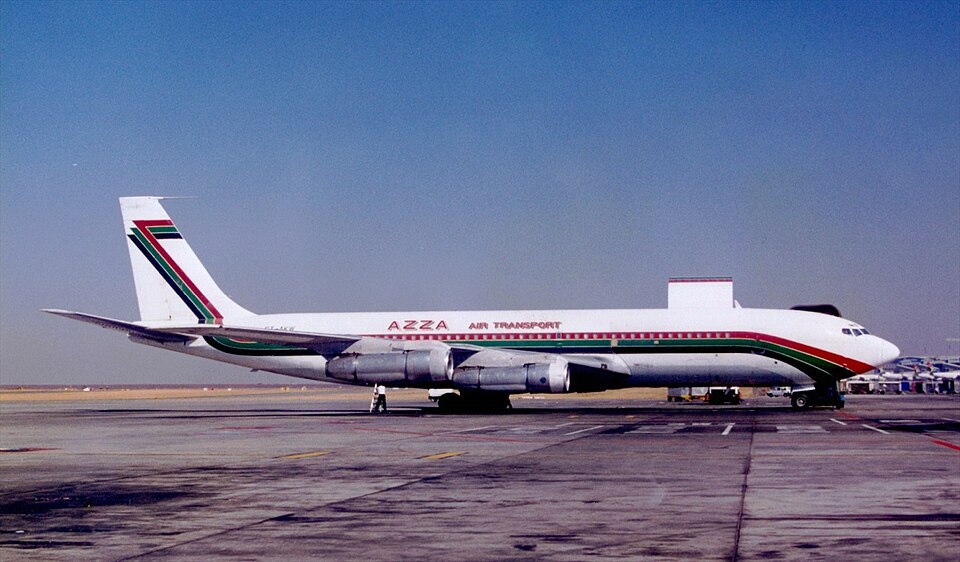
On 21 October 2009 at approximately 1131 UTC, a Boeing 707-330C cargo aircraft, registration ST-AKW, operated by Azza Air Transport, crashed after takeoff from Sharjah International Airport. The accident site was located 1.6 kilometers (0.86 nautical miles) from the end of runway 30 (threshold of runway 12). The aircraft was completely destroyed by ground impact and fire. All six crew members on board sustained fatal injuries.
The flight was a cargo transport operation. The aircraft had departed from Sharjah International Airport. No further details about the flight history were included in the report.
Aircraft and Crew Information
The accident aircraft was a Boeing 707-330C, registration ST-AKW. It was powered by four Pratt & Whitney JT3D-3B turbofan engines. The operator, Azza Air Transport, held the maintenance and control functions as the lessor of the aircraft to Sudan Airways, the lessee. The crew comprised six members: a captain, a co-pilot, and a flight engineer, among others.
The captain's details, co-pilot's details, and flight engineer's details were documented in the report. The captain held a valid Airline Transport Pilot License and had accumulated significant flight experience. The co-pilot also held a valid license and had experience on the Boeing 707. The flight engineer was licensed and trained.
Investigation
The Air Accident Investigation Sector of the General Civil Aviation Authority (GCAA) of the United Arab Emirates led the investigation as the State of Occurrence. The investigation team included representatives from the GCAA, an accredited representative from the Sudan Civil Aviation Authority, and an accredited representative from the United States National Transportation Safety Board, with advisors from the FAA, Boeing, and Pratt & Whitney.
The investigation examined the aircraft's maintenance history, the No. 4 engine and its components, the cockpit voice recorder (CVR), and the flight data recorder (FDR). The CVR and FDR were recovered and examined. The aircraft's wreckage and impact information were documented. The No. 4 engine core cowls were examined for signs of failure. The fuel control units were also examined. The investigation did not state a probable cause.
Meteorological Information
The meteorological information at the time of the accident was included in the report. The weather conditions were documented, including wind and visibility, but specifics are not detailed in this summary.
Conclusion
The aircraft was completely destroyed, and all occupants sustained fatal injuries. The investigation concluded without stating a probable cause, according to the available report summary.