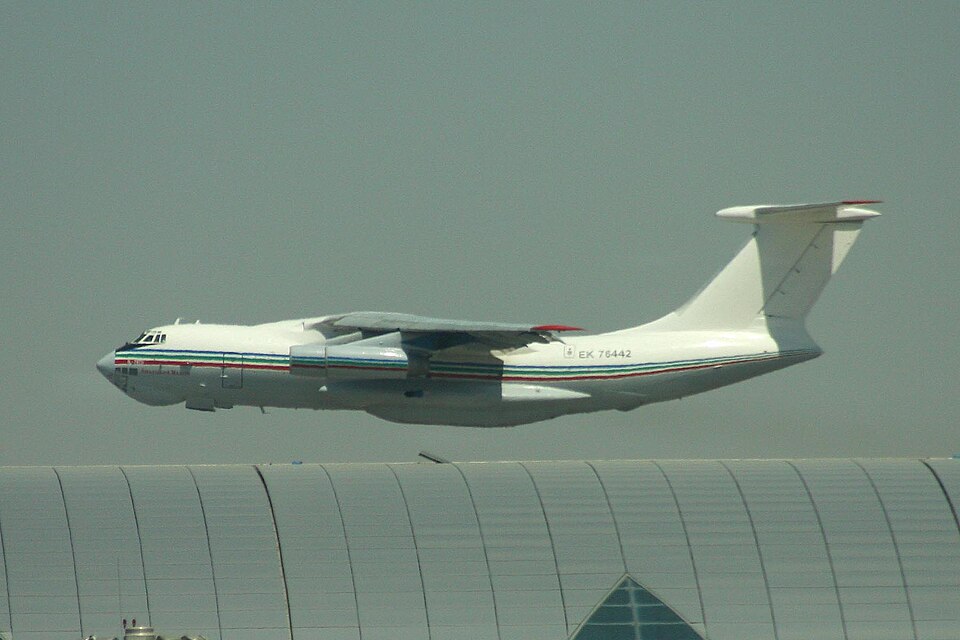
History of the Flight
On 27 October 2010, an Ilyushin 76 TD, registration EK76442, operated by Phoenix Avia, departed the cargo stand at Dubai International Airport at approximately 0300 LT. The aircraft reached Runway 12R via entry M4 at approximately 0313. According to the crew, the Aircraft Flight Manual required advancing all four engines' power to 80% for one minute as part of line-up checks. About 20 seconds after power advancement, the captain observed low oil pressure on engine 2 accompanied by a vibration red alert. He retarded the engine 2 throttle lever and instructed the flight engineer to shut down engine 2 using the fuel cut handle. The other three throttle levers were also retarded. The crew informed Dubai ATC of the engine problem and requested to return to the stand. They were instructed to vacate the runway via exit M5 and park at cargo stand E23, where the crew disembarked normally. No emergency was declared.
Injuries to Persons
No injuries were reported. The aircraft carried 7 crew members and no passengers.
Damage to Aircraft
The aircraft was intact except for confined engine damage. Engine 2's last stage turbine blades were severely damaged, with some disintegrated and departed the engine. The nose cowl, inlet guide vanes, and first stage fan blades were undamaged. No adjacent structure was affected by debris. A fuel leak was observed under the left wing but could not be linked to engine debris.
Aircraft and Engine Information
The aircraft was an Ilyushin 76 TD, manufactured with MSN 1023414450, registered in the Republic of Armenia. Engine 2 was a D-30KP-2, serial number 03053019302028, manufactured by NPO Saturn on 18 May 1992. It had undergone two overhauls, the last on 26 February 2003. Time since new was 8622 hours; time since last overhaul was 2476 hours. Guaranteed service life was 2000 hours, extended by stages up to 2666±30 hours.
Tests and Research
The engine was removed and examined by the manufacturer. Teardown revealed:
- Most rotor blades of turbine stages 2 to 6 were ripped off.
- Failure of all stage 3 nozzle guide vanes, and nicks and tear-out on stages 4, 5, and 6 nozzle guide vanes.
- Failure of vane 40 in stage 2 high-pressure turbine nozzle guide vane, with evidence of material fusion due to overheating.
- Thermal damage to combustion cans, including burning-out, distortion, and cracking.
- No failures in compressor flowpath.
- Fuel nozzle testing showed reduced flow through primary orifices, irregular atomization, and clogging with foreign deposits.
- Deposits were analyzed as containing ferrous and sulfur oxides, easily removed, with no corrosion.
- Fuel drained from the constant-speed drive governor showed existent gum content exceeding permissible limits (33.5 mg per 100 ml versus limit of 3 mg per 100 ml for TS-1 fuel).
Additional Information
Existent gum is a heavy crude oil component that can accumulate at fuel nozzle orifices, narrowing them and causing irregular spray, leading to a concentrated flame torch. The torch concentrates heat, causing thermal stress due to differential convection.
Analysis
The investigation eliminated foreign object ingestion as the compressor was undamaged. The failure sequence was inferred as:
- Overheating stress caused failure of stage 2 turbine nozzle guide vane No. 40.
- Local increased gas temperature resulted from malfunctioning fuel nozzles partially blocked by resin deposits.
- The resin deposits were attributed to existent gum accumulation, confirmed by the fuel sample's high gum content.
- Accumulated gum likely caused a flame torch, overheating the combustion can and the stage 2 vane, leading to disintegration and downstream damage.
- The deposits likely accumulated after the last overhaul in 2003, as on-wing inspections did not include bench inspection of fuel nozzles.
- Borescopic inspections for engine prolongation did not include fuel nozzle inspection.
- Fuel quality assurance was difficult due to diverse operations across continents.