Casualties unknown

1989-10-29: DE Havilland DHC-6-300 (N707PV) — Halawa,molokai, HI

Halawa,molokai, HI, US

On October 29, 1989, a DE Havilland DHC-6-300 (registration N707PV) was involved in an aviation accident near Halawa,molokai, HI. Investigators recorded the probable cause as: THE AIRPLANE'S CONTROLLED FLIGHT INTO TERRAIN AS A RESULT OF THE DECISION OF THE CAPTAIN TO CONTINUE FLIGHT UNDER VISUAL FLIGHT RULES AT NIGHT INTO INSTRUMENT METEOROLOGICAL CONDITIONS (IMC), WHICH OBSCURED RISING MOUNTAINOUS TERRAIN. This summary draws on records from the U.S. National Transportation Safety Board (NTSB) historical archive.

Sourcesthe U.S. National Transportation Safety Board (NTSB) historical archivePrimary reportUpdated 1781061362Data APIEditorial standards
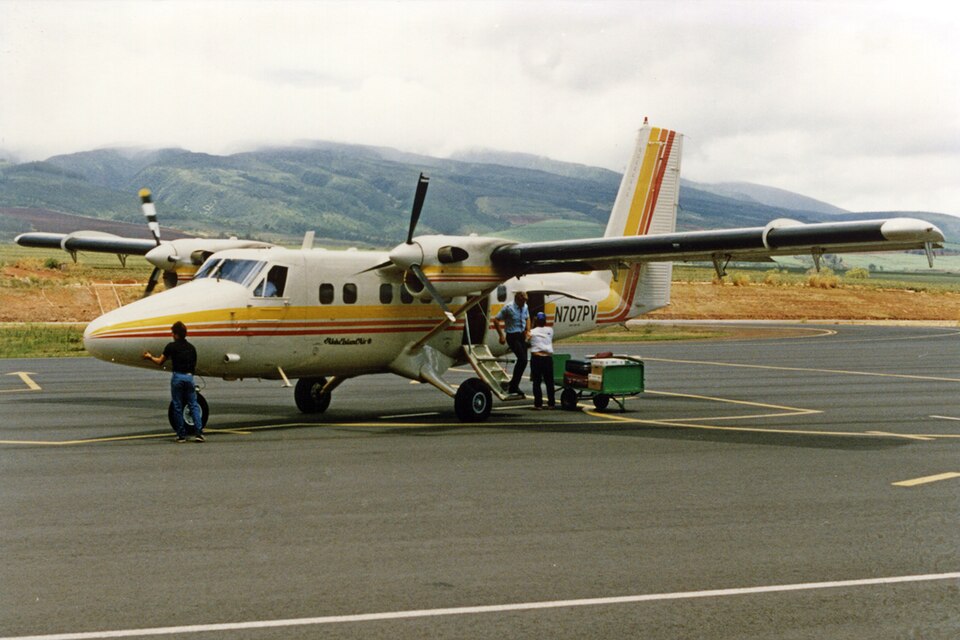
Aircraft registered N707PV
Aircraft registered N707PV. Photo: Brian T Richards / CC BY-SA 4.0, via Wikimedia Commons

On a scheduled night flight from Maui to Molokai, a De Havilland DHC-6 (N707PV) struck mountainous terrain near Halawa Bay, Hawaii, after the captain made a navigational error. Low clouds obscured mountain tops. Investigation found evidence of inadequate management and FAA oversight.

Synopsis

Aloha Islandair Flight 1712, a De Havilland DHC-6 aircraft registered as N707PV, was operating a scheduled passenger flight from Maui to Molokai, Hawaii, at night. The aircraft collided with mountainous/hilly terrain near Halawa Bay, Hawaii, while en route.

Sequence of Events

The impact occurred at an elevation of about 500 feet, shortly after the aircraft had descended over water and then crossed the shoreline. Evidence indicated that the captain had made a navigational error and mistakenly believed that he was circumnavigating the northern portion of Molokai Island. The aircraft crashed while on a heading that was parallel with the island's northern shoreline. Low clouds obscured the mountain tops in the area of the accident.

Findings

The investigation found evidence of inadequate supervision of personnel, training, and operations by Aloha Islandair management. Additionally, there was evidence of insufficient oversight of Aloha Islandair by the Federal Aviation Administration (FAA) during a period of the airline's rapid operational expansion.

Probable Cause

The investigation did not explicitly state a probable cause, but evidence pointed to the captain's navigational error, combined with inadequate management supervision and insufficient FAA oversight.

Investigation report by the U.S. National Transportation Safety Board (NTSB) historical archive. Original record: https://carol.ntsb.gov/event/20001213X29576. This page is a structured re-presentation; facts and quotes are in the National Transportation Safety Board (NTSB), United States.