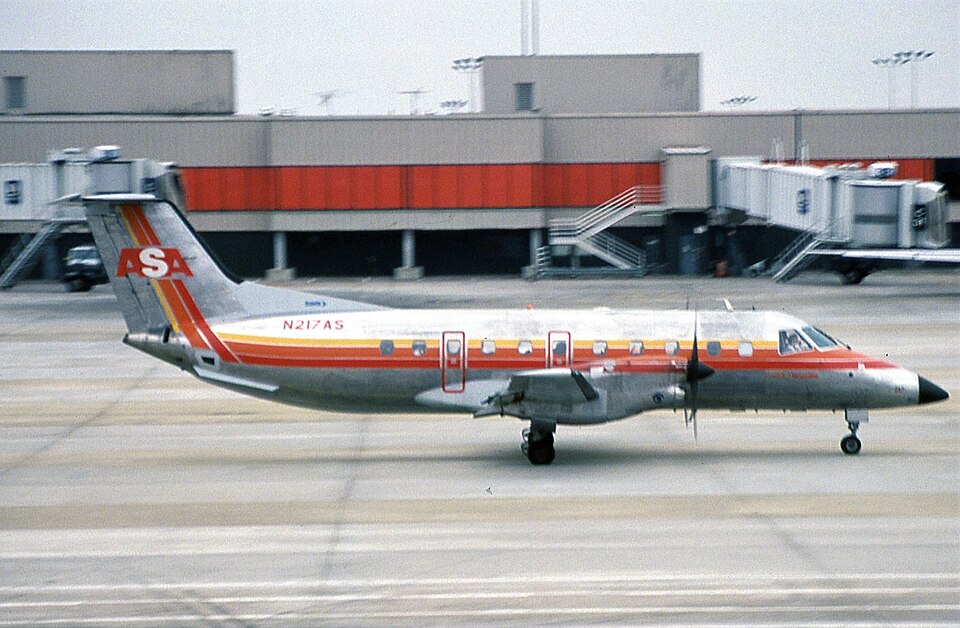
On April 9, 1990, an Embraer EMB-120 (registration N217AS) operated by Atlantic Southeast was involved in an aviation accident near Gadsden, AL. Investigators recorded the probable cause as: INADEQUATE VISUAL LOOKOUT BY THE PILOTS OF BOTH AIRCRAFT, WHICH RESULTED IN THEIR FAILURE TO SEE-AND-AVOID ONCOMING TRAFFIC. A FACTOR RELATED TO THE ACCIDENT WAS: THE SUN'S GLARE, WHICH RESTRICTED THE VISION OF THE CESSNA 172 PILOT. This summary draws on records from the U.S. National Transportation Safety Board (NTSB) historical archive.
An Embraer EMB-120 and a Cessna 172 collided head-on about 2.5 miles south of the airport. The EMB-120 landed safely after losing its right horizontal stabilizer, while the Cessna crashed.
Incident Overview and Aircraft Involved An Atlantic Southeast Airline flight operating an Embraer EMB-120, registration N217AS, departed runway 24 under an IFR clearance. The aircraft turned left to an east heading and climbed to an assigned altitude of 5,000 feet MSL. Before radar contact was established with air traffic control, the Embraer converged with a Cessna 172, registration N99501, which was heading westbound toward the setting sun. ## Collision and Aftermath A head-on collision occurred approximately 2.5 miles south of the airport. During impact, the right horizontal stabilizer of the Embraer EMB-120 separated from the aircraft, but it continued flying and made a safe landing. The Cessna 172 entered an uncontrolled descent and crashed. ## Witness and Crew Accounts A witness who observed the collision did not note any evasive action by either aircraft before impact. The crew of the Embraer EMB-120 reported seeing the Cessna moments before impact. The captain stated he took immediate evasive action by pushing the nose down but was unable to avoid the collision. A flight attendant on the Embraer recalled a 'thump' before the aircraft started a descent.
A SkyWalk Join't 3 paraglider crashed into the ground near Las Vizcachas, Chile, on September 1, 2024. The pilot and passenger sustained serious spinal…
PARAPENTE (ULTRALIVIANO NO MOTORIZADO)·2024-09-01DGAC Chile
A Cessna 172N struck electrical cables while on final approach to land at Aucó Aerodrome in Chile. The pilot was uninjured, but the aircraft sustained damage…
A Bombardier DHC-8-402 suffered a tail strike during landing at Puerto Williams on September 9, 2024. All 76 occupants were unharmed, but the aircraft…
A MYD JS-MD 3 glider veered off the runway and struck a wall at Vitacura Aerodrome on January 6, 2025. The pilot was uninjured, but the aircraft sustained…
A recreational paraglider flight in Puchuncaví, Chile, ended with the pilot sustaining serious injuries after a rapid descent and impact with a hillside on…
PARAPENTE (ULTRALIVIANO NO MOTORIZADO)·2025-03-29DGAC Chile
A Tecnam P2006T landed on its belly at an aerodrome in Poland after the crew failed to confirm landing gear deployment. The incident resulted in no injuries…