Casualties unknown

Hydraulic Failure and Nose Gear Malfunction During Approach to Miami (N751MA)

Miami, FL, US

On February 22, 1996, a Boeing 707-323C (registration N751MA) operated by Millon Air was involved in an aviation accident near Miami, FL. Investigators recorded the probable cause as: The utility hydraulic system relief valve housing failed due to fatigue cracking, resulting in the loss of all hydraulic fluid. This summary draws on records from the U.S. National Transportation Safety Board (NTSB) historical archive; 2 related events involving the same aircraft type or operator are linked below.

Sourcesthe U.S. National Transportation Safety Board (NTSB) historical archivePrimary reportUpdated 2026-06-10Data APIEditorial standards
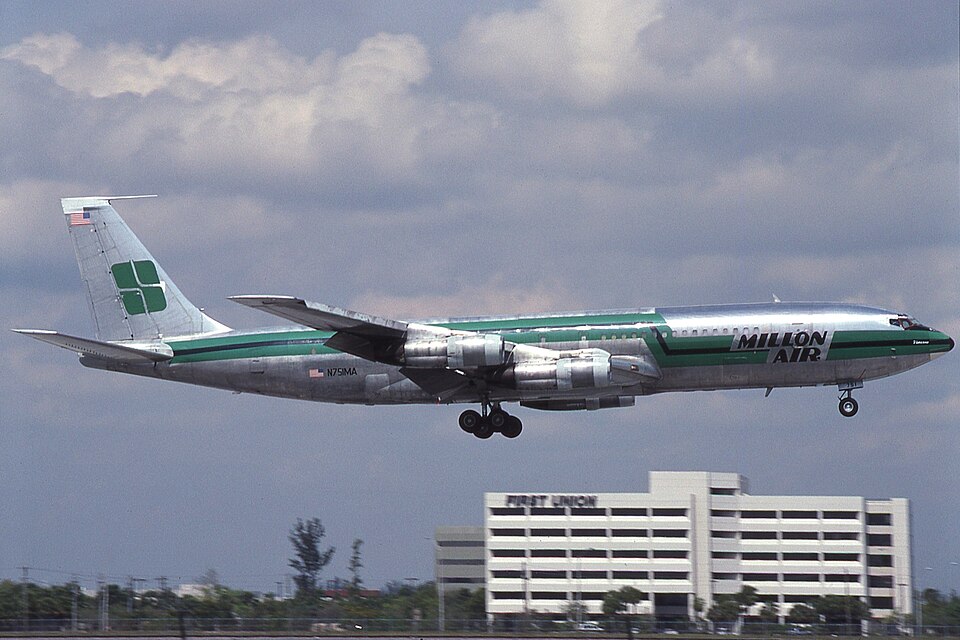
Aircraft registered N751MA
Aircraft registered N751MA. Photo: Lewis Grant / CC BY-SA 4.0, via Wikimedia Commons

An aircraft lost all hydraulic fluid from the utility system one hour after departure. The flight engineer manually extended the main gear but could not lower the nose gear. The aircraft landed with the nose gear retracted. Investigation revealed a fatigue-cracked relief valve housing caused the fluid loss.

Incident Description

One hour after departure, the aircraft experienced a complete loss of hydraulic fluid from the utility hydraulic system. During the approach to Miami, the flight engineer manually extended the main landing gear. However, attempts to manually lower the nose landing gear were unsuccessful. A fly-by of the tower confirmed that the nose gear doors were open and the nose gear remained retracted. The pilot landed the aircraft in this configuration.

Post-Incident Examination

After landing, the aircraft was raised, and the nose landing gear was successfully extended using the normal manual extension system. The aircraft was then moved to a hangar, where the nose gear was retracted and manually extended four additional times without any evidence of failure or malfunction.

Investigation Findings

The investigation determined that the utility hydraulic system relief valve housing failed due to fatigue cracking. This failure resulted in the loss of all hydraulic fluid from the system.

Flight Engineer Experience

The flight engineer had been flying as a flight engineer with the operator for 21 days and accumulated 25 flight hours in that role. He reported a total of 54 flight hours as a flight engineer in the Boeing 707 and 3,800 flight hours as a flight engineer in the Douglas DC-8.

Probable cause

The utility hydraulic system relief valve housing failed due to fatigue cracking, resulting in the loss of all hydraulic fluid.

Investigation report by the U.S. National Transportation Safety Board (NTSB) historical archive. Original record: https://carol.ntsb.gov/event/20001208X05294. This page is a structured re-presentation; facts and quotes are in the National Transportation Safety Board (NTSB), United States.