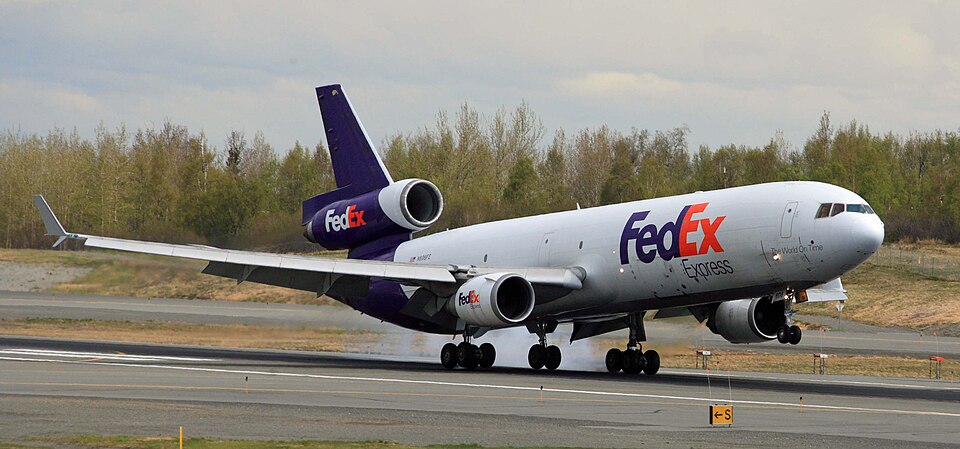
Incident Overview
During the landing roll, the center landing gear (CLG) on an MD-11 failed in a rearward direction. The lugs on the upper attach point of the lower drag brace on the CLG failed, causing the landing gear retraction cylinder to be pulled apart. This resulted in a loss of hydraulic fluid in the #3 hydraulic system.
Metallurgical Findings
A metallurgical examination of the failed lug revealed evidence of overload, indicating the component was subjected to forces beyond its design limits.
Flight Data Recorder Analysis
The digital flight data recorder (DFDR) recorded a momentary peak in vertical and longitudinal accelerations approximately 5.75 seconds after main landing gear touchdown and 2.5 seconds after nose wheel touchdown. During this event, the vertical acceleration momentarily reduced while the longitudinal acceleration momentarily increased.
Manufacturer's Assessment
According to McDonnell-Douglas, the CLG was capable of entering a divergent, longitudinal oscillation that could lead to failure of the lower drag brace lugs. The manufacturer documented five prior identical events. After the first three events, McDonnell-Douglas replicated the phenomenon twice using instrumented airplanes. Subsequently, they issued a service bulletin recommending modifications to the CLG brakes and anti-skid system. The accident airplane had received these modifications.
Post-Incident Testing
Additional testing conducted by the operator to determine the loads on the CLG during landing did not identify any high loads. The underlying cause of the CLG oscillation that led to the failure remained undetermined.