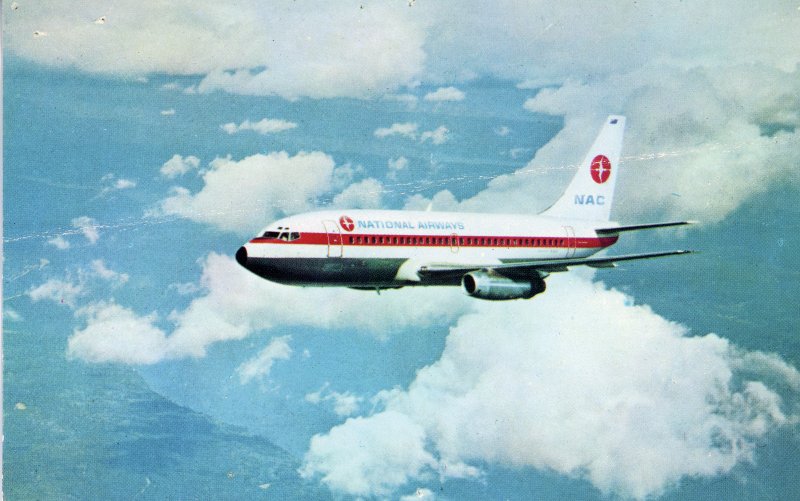
On September 16, 2000, a Boeing 737-49R (registration N461PR) was involved in an aviation accident near Flushing, NY. Investigators recorded the probable cause as: The tug operator failed to respond to stop signals from a wing walker because his attention was focused on the other wing walker, resulting in the aircraft rudder striking a parked plane. This summary draws on records from the U.S. National Transportation Safety Board (NTSB) historical archive.
Photo: San Diego Air & Space Museum Archives / Public domain, via Wikimedia Commons
An MD-80 sustained damage to its rudder after a tug operator failed to stop the aircraft during a nighttime pushback operation.
What happened
During a nighttime pushback operation, an MD-80 was being moved by a tug operated by three ground crew employees. At the time of the incident, weather conditions included 10 statute miles of visibility and scattered clouds at 8,500 feet MSL.
Both wing walkers involved in the operation were equipped with night wands. One wing walker observed that the aircraft was approaching a parked airplane too closely and provided signals to stop the tug operator several times. However, the tug operator stated that while one wing walker signaled him to stop, his attention was focused on the other wing walker. By the time the operator applied the brakes, the rudder of the MD-80 had already struck the parked aircraft.
Findings
The tug operator was distracted by looking at one wing walker instead of responding to the signals from the other.
The operator's attempt to brake occurred too late to prevent the collision.
Probable cause
The tug operator failed to respond to stop signals from a wing walker because his attention was focused on the other wing walker, resulting in the aircraft rudder striking a parked plane.