Incident Overview
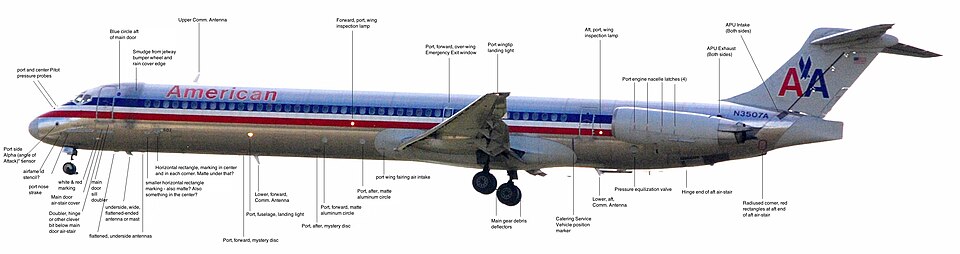
During initial climb-out, the airplane was struck by lightning. Shortly thereafter, dark smoke entered the forward area of the passenger cabin. The crew declared an emergency. Flight attendants, with assistance from a passenger, cut a hole in the overhead panel and discharged two hand-held fire extinguishers. The airplane landed uneventfully, and an emergency evacuation was conducted without incident.
Examination Findings
Examination of the airplane revealed that a deactivated navigational antenna located in the tail cone had been struck by lightning. Attached to the antenna were two coaxial cables, which were tie-wrapped together, fed into the cabin, and attached along the upper left-hand side of the fuselage between the insulation blankets and overhead panels. The cable ends were observed to be mechanically cut and had been fastened above row 7AB, in the area of the most fire damage. The insulation to the right of the cable ends was cratered and burrowed. The cable ends were not protected or grounded.
Engineering Context
The cables had been cut and partially removed in accordance with an engineering change order (ECO) developed by the operator, so a more advanced system could be installed. According to the procedure, the cable ends were to be covered with heat shrink tubing or other suitable material. Fifty-seven of the operator's 259 MD-80 airplanes had undergone the partial removal of the cables, and 21 airplanes still had the full Omega antenna system installed.
Corrective Action
As a result of this incident, the operator implemented a revised engineering change order (ECO) that stated: "the cable which runs down the vertical stabilizer is cut and grounded to structure in the aft accessory compartment. A portion of the cable, which runs through the aft pressure bulkhead, is removed and the feed through is sealed. The intent of this action is to protect the cable from lightning damage." As of January 11, 2001, the revised ECO had been implemented on all 78 airplanes.