Casualties unknown

Ramp Agent Incident Involving Propeller-Driven Airplane: Investigation Findings (N935HA)

Washington, DC, US

On August 5, 2001, a DE Havilland DASH 8-100 (registration N935HA) operated by Name was involved in an aviation accident near Washington, DC. Investigators recorded the probable cause as: The ramp agent's impaired performance due to his hyperthyroidism, which was exacerbated by the heat and was inadequately controlled by medication, and possibly also due to the use of an antianxiety medication. This summary draws on records from the U.S. National Transportation Safety Board (NTSB) historical archive; 4 related events involving the same aircraft type or operator are linked below.

Sourcesthe U.S. National Transportation Safety Board (NTSB) historical archivePrimary reportUpdated 2026-06-10Data APIEditorial standards
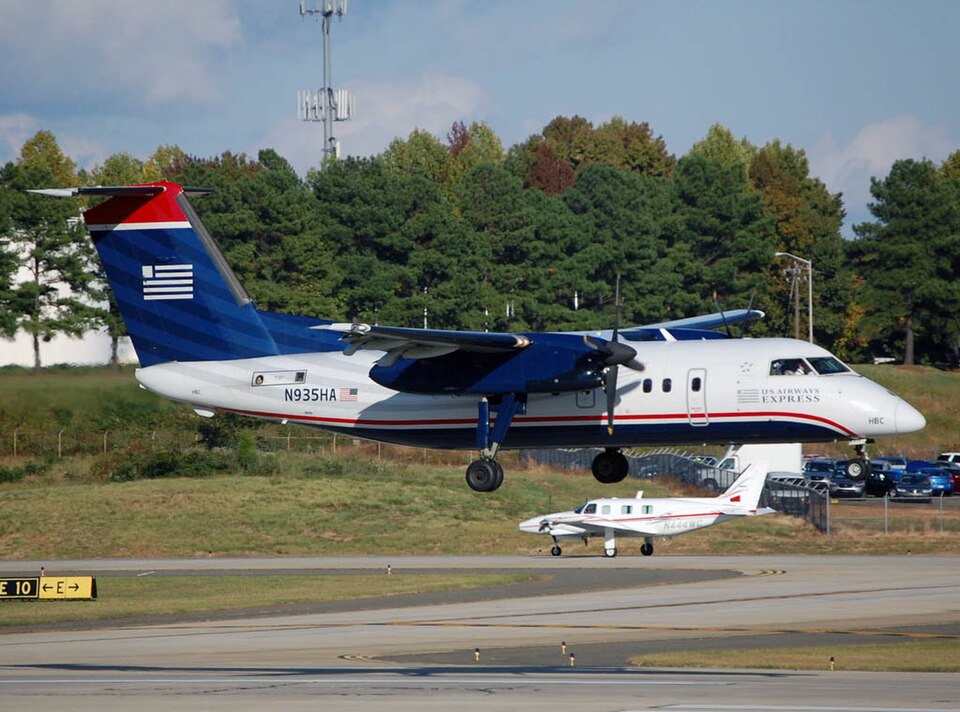
Aircraft registered N935HA
Aircraft registered N935HA. Photo: James Willamor from Raleigh, NC, USA / CC BY-SA 2.0, via Wikimedia Commons

Investigation of a ramp agent incident near a propeller-driven airplane found carelessness was inadvertent and out of character; the agent was fatigued and medicated.

Investigation Overview

The investigation into an accident involving a ramp agent working near a propeller-driven airplane has concluded with several findings. The ramp agent had received both training and experience in working around propeller-driven aircraft. Coworkers described the individual as safety-conscious and a hard worker, and the carelessness exhibited during the accident was characterized as inadvertent and out of character.

Contributing Factors

According to the investigation, the surface of the ramp was not a factor in the accident. However, the ramp agent was at the end of his shift on a very hot day. Additionally, the agent was taking medication for a medical condition that had the potential to impair judgment. These conditions may have played a role in the incident.

Personnel Background

Statements from coworkers substantiated the finding that the ramp agent’s usual behavior was safety-conscious. The investigation did not attribute the incident to any systemic failures or environmental hazards beyond the personal factors noted.

Conclusion

The investigation did not assign a probable cause for the accident, but rather highlighted the combination of end-of-shift fatigue, high temperature, and medication as factors that could have contributed to the inadvertent carelessness.

Investigation report by the U.S. National Transportation Safety Board (NTSB) historical archive. Original record: https://carol.ntsb.gov/event/20010904X01867. This page is a structured re-presentation; facts and quotes are in the National Transportation Safety Board (NTSB), United States.