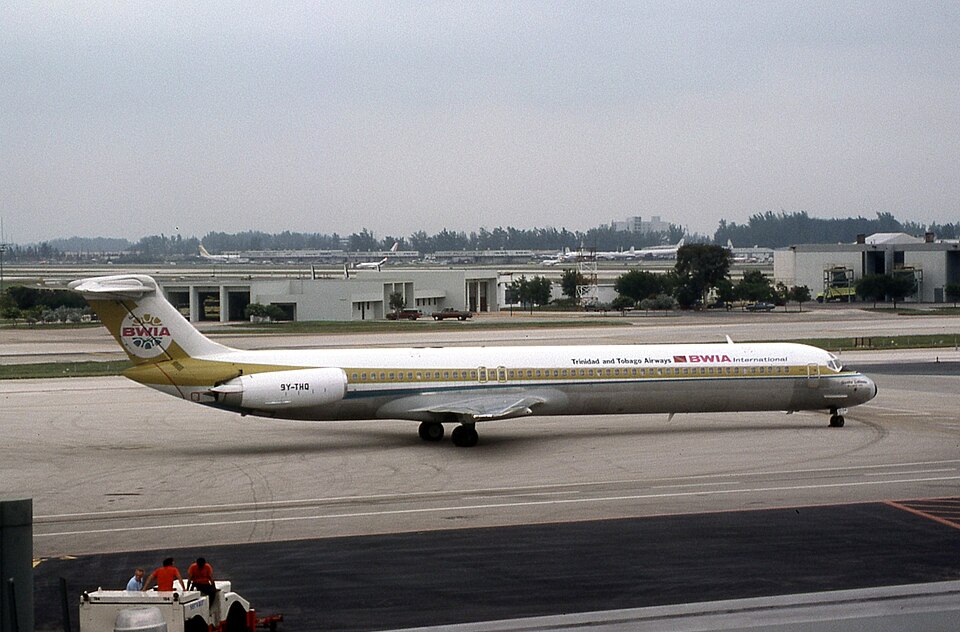
Incident Summary
The captain reported that the first officer was flying the approach and landing. Prior to descent, a briefing was conducted for the localizer 30 approach to Miami International Airport (MIA). During the landing on runway 30, the aircraft floated for a period after the first officer flared. After several seconds, the captain assumed control during the landing roll. Believing the aircraft would overrun the runway and collide with an approach light structure, the captain steered to the left side of the runway and brought the aircraft to a complete stop with the nose wheel in a sandy area. The captain then shut down the engines and deplaned the passengers. The aircraft was subsequently towed to the gate.
Flight Data Recorder Analysis
Readout of the digital flight data recorder (DFDR) indicated that the descent from cruise flight to 10,000 feet appeared normal, with the aircraft maintaining 250 knots indicated airspeed. During the descent from 10,000 feet, the airspeed began to increase, exceeding 300 knots as the aircraft descended through 5,000 feet. An airspeed of over 300 knots was maintained until the aircraft was within 4 miles of the runway and at an altitude of 1,500 feet.
The aircraft crossed the runway threshold at a radio altimeter altitude greater than 100 feet and at an airspeed exceeding 200 knots (at least Vref + 70 knots). Touchdown speed was approximately 150 knots. Full wing spoilers or speed brakes were deployed between 4.5 and 2.5 miles remaining to the runway, corresponding to an altitude range of 1,700 to 800 feet. Wing slat extension began at an altitude of 1,200 feet and 290 knots. Wing flap extension began at 900 feet and 280 knots. Landing gear was extended at 1.5 miles from the runway at an altitude of 400 feet.
After landing, the ground spoilers were not deployed. The aircraft appears to have touched down more than 5,000 feet past the runway threshold. The aircraft came to rest approximately 90 degrees left of the runway heading.