Pilot Account
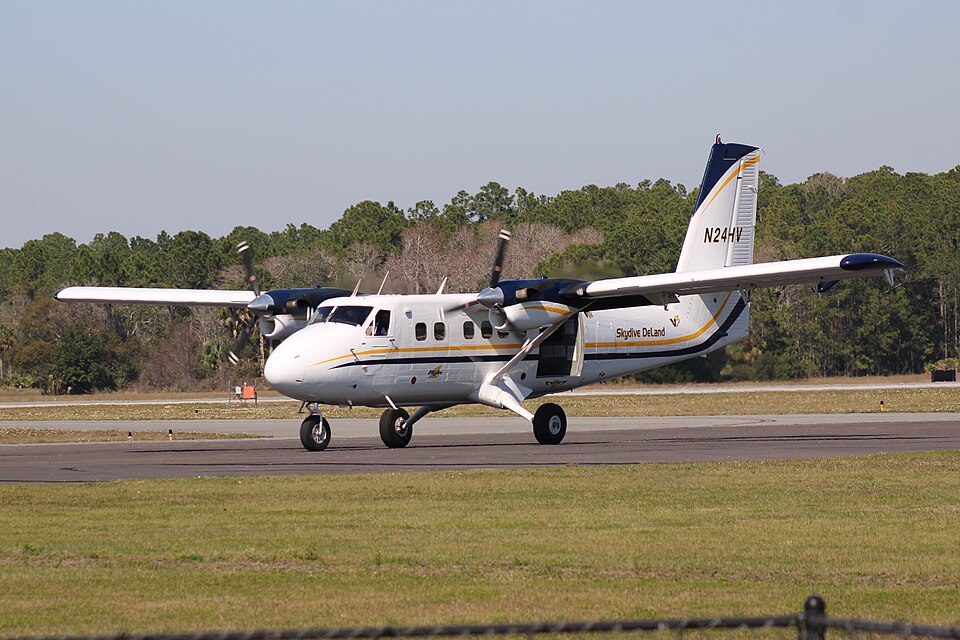
The pilot stated that after 14 jumpers exited the aircraft at 13,500 feet southwest of the airport, he initiated a descent to the northeast. He approached the airport from the northeast, overflew the airport, and made a left turn to enter the downwind leg for runway 23. During the turn, he observed parachutes on the ground and in the air, including a tandem jumper to the southwest, and believed he had accounted for all jumpers. As he turned left, he saw a flash of colors, felt an impact, and experienced drag from the left wing. He landed the aircraft as soon as possible.
Radar Data
Radar data indicated that the aircraft was at about 1,300 feet mean sea level (msl) when approaching runway 5/23 from the northeast. It overflew runway 23 near midfield at approximately 1,100 feet msl, and was between 900 and 800 feet msl during the left bank entering the downwind for runway 23. The last radar capture was at 300 feet msl as the aircraft approached runway 23.
Jumper Statements
One jumper noted that the parachute landing zone was on the airport adjacent to the left side of runway 30. A master tandem jumper stated that the pilot did not provide a briefing on which runway or approach he intended to use. According to this jumper, the norm is for jumpers to avoid crossing runways below 1,000 feet and to stay about 300 feet from runways, while pilots should avoid jumpers at all times. Due to the high number of jumps per day, no briefing is given before each flight, and approach and runway selection depend on the individual pilot.
Video Evidence
The cinematographer, who jumps with the last tandem jumpers, carried video equipment that captured the collision. The tandem chute deployed at 3 minutes and 7 seconds into the video, followed by the cinematographer's chute 13 seconds later. During descent, the cinematographer removed the helmet-mounted camera, looked into the view, made remarks, and replaced the camera. The sky was overcast with good visibility. The view panned right, capturing three skydivers with deployed chutes above. At approximately 4 minutes and 54 seconds, a sound similar to an airplane engine increased in level for 5 seconds. At 4 minutes and 59 seconds, the view panned left and a sound like an impact was heard. The view became blurry and panned rapidly. At 5 minutes and 2 seconds, three frames showed an aircraft in close proximity banking away to the right. The view continued panning rapidly for about 6 seconds, showing the ground, sky, and parachute. The camera stabilized and recorded until ground impact at 5 minutes and 46 seconds.
Operational Procedures
A representative of the operator stated that only verbal guidance is given to pilots to follow FAA rules, leaving approaches and runway selection to their discretion. The acting airport manager said there is no formal agreement for airport operations between the skydive operator and the city, only a lease agreement. The city developed a voluntary noise abatement procedure outlining areas to avoid.
Pilot Concerns
Several pilots at the airport reported that for several years they had communicated safety concerns regarding the skydive operator's approaches and runway selection to the city, but the city did not address the situation.